#12, Pompei
Sunday, 4/2, Palm Sunday.
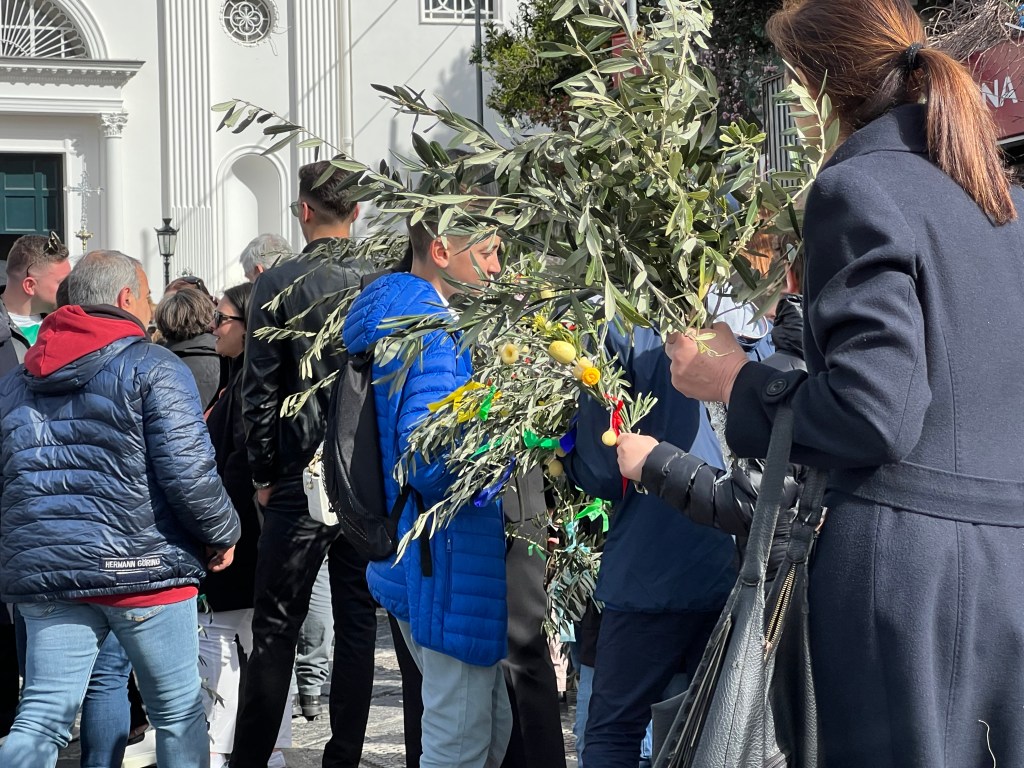
Up early, I had coffee on the balcony and watched the passing scene. This was Palm Sunday. Bells were ringing as parishioners streamed by on this holy day carrying olive branches in their hands heading for a little church nearby. It apparently is the custom here to carry olive branches and not palm fronds to Palm Sunday services.
As pre-arranged, a driver arrived at 9:30 a.m. to take us on to our next destination – Pompei.
Climbing upward on the Positano city streets, we headed out of town and higher up along the coast on our way to Pompei. Approaching the city, traffic had increased and throngs of people, carrying olive branches and flowers were exiting their vehicles headed for a church up the road. Our driver, mindful of the pedestrians, slowly drove through the crowd of the faithful who were assembling outside a church where a priest was holding mass. A procession of the cross apparently was a part of the ceremony that we briefly observed as we passed by. The crowds now behind us, we soon arrived at The Maiuri Hotel where we would stay for two nights. Checking in, but not yet able to access our room, we set out toward the center city several blocks away.
Here, as it was in Venice, Florence and then in Rome, I relied on and was thankful for Mark as the navigator. Streets are complicated and Mark took the lead in getting us to our destinations – and back, relieving me of that stress.
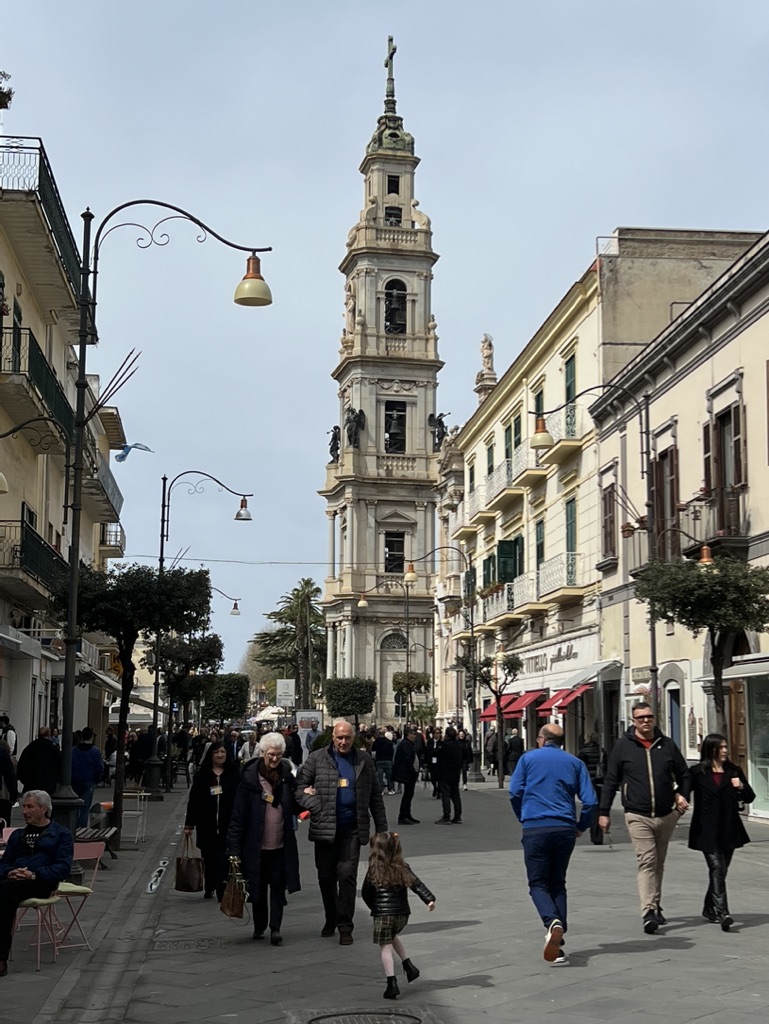
In the city center this portion of the main street was a pedestrian thoroughfare where people were strolling about, enjoying the day. Bench seating was provided where we would sit and appreciate all that was happening around us.
A street side accordion player: the melodies floating in the air were reminiscent of an idyllic feeling of Italy. We sat for a time just taking in the music and all the activity around us; groups of people stopping to chat, a man with his small dog in his arms, parents with small children in strollers, another child carefree and happy keeping several steps ahead of his mother, yet another small boy intently maneuvering on his skateboard, an older couple strolling along arm in arm.
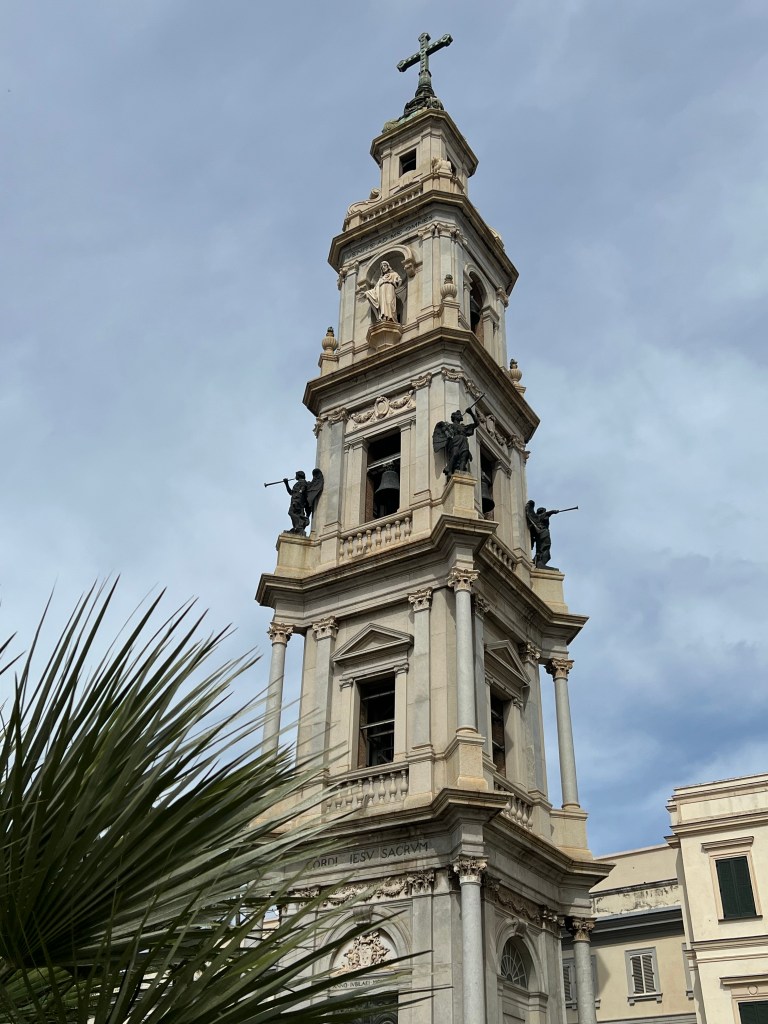
Further up the street we entered the courtyard of a church, its steeple stretching high into the sky. There people were milling about, many with their olive branches having been or about to attend Palm Sunday services, while nearby others were enjoying the bright sunny day at an outdoor cafe. This all exuded a very peaceful feeling.
At the suggestion of our hotel clerk, we arranged for transportation while in Pompei.
We were in for a treat.
The taxi service was that of a son and his father, and we were blessed having the father, Giuseppe arrive to drive us to the Pompei excavation site. He was a beaming beacon of light, friendliness and exuberant happiness. Very talkative, but with very limited English, he showed us another way to communicate using our smart phones. He would speak Italian and have his cell phone interpret in English. While Mark and I both know about translators on our phones, Giuseppe’s use of it opened a whole new way of communicating in person with another. We in turn then could convey our own thoughts back to Giuseppe.
We learned that his son Gennaro and he loved cars and driving, so this business was a way to enjoy both. Additionally, I believe Giuseppe truly enjoys meeting and talking with people.
He drove us to our meeting spot near the Pompei ruins and was intent on assuring us he would arrive after our tour to pick us up and return us to Hotel Maiuri.
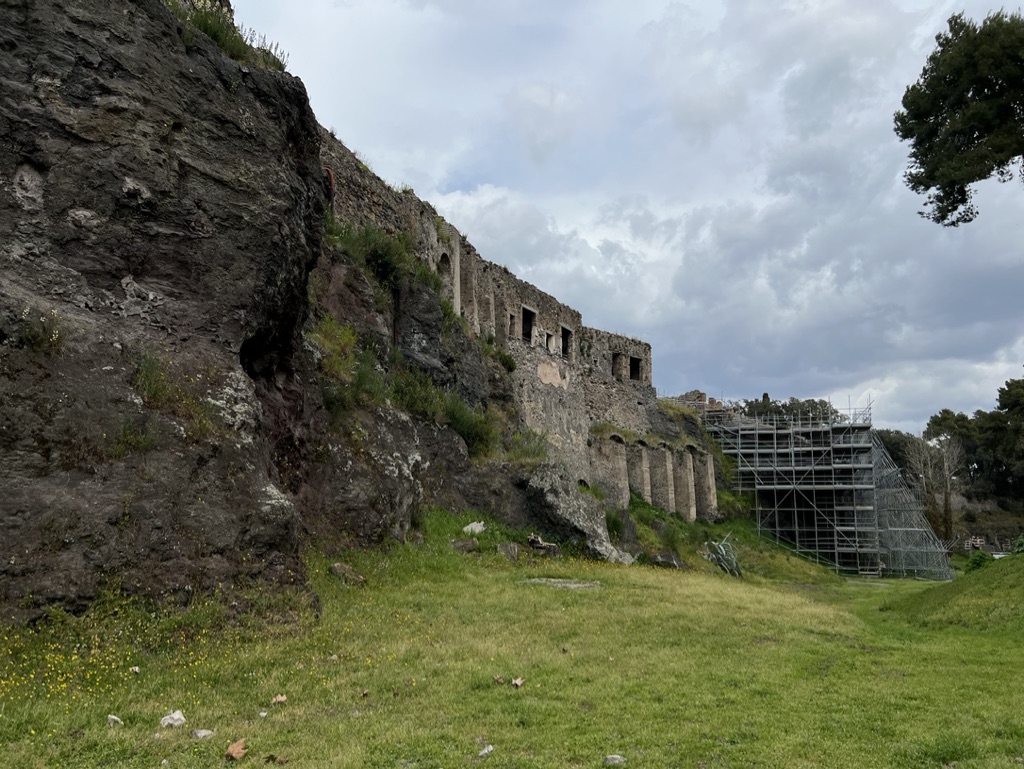
Pompei ruins. As Giuseppe drove us, we passed by tall stone walls set back from the road. These walls we would discover were part of the once buried city of Pompei.
Ahh, what discoveries would we be seeing on the other side of those walls?
Pompei has always intrigued me as photos and TV programs have shown the results of excavations of that city that was buried after the eruption of Mt. Vesuvius. We would learn much more about Pompei by way of two separate tours we had pre-arranged.
This afternoon tour included just Mark, me and our very knowledgable guide Sasa. He is a third generation guide of Pompei and was eager to guide us through to some of the most significant places in the uncovered city starting with a background history.
From the starting point where Sasa began, we found we would have been at the edge of the sea. Of course, now we were far from any seaport as the volcanic eruptions and time had rearranged the landscape over the centuries since Pompei was buried.
Pompei had not begun as a Roman city, but when the Romans took over, they dramatically improved the lives of the people who were made up of several ethnic groups including Greeks, Assyrians, Egyptians, Africans. Roman rule allowed the inhabitants to practice their own religions while managing the governing of the people and offering them protection.
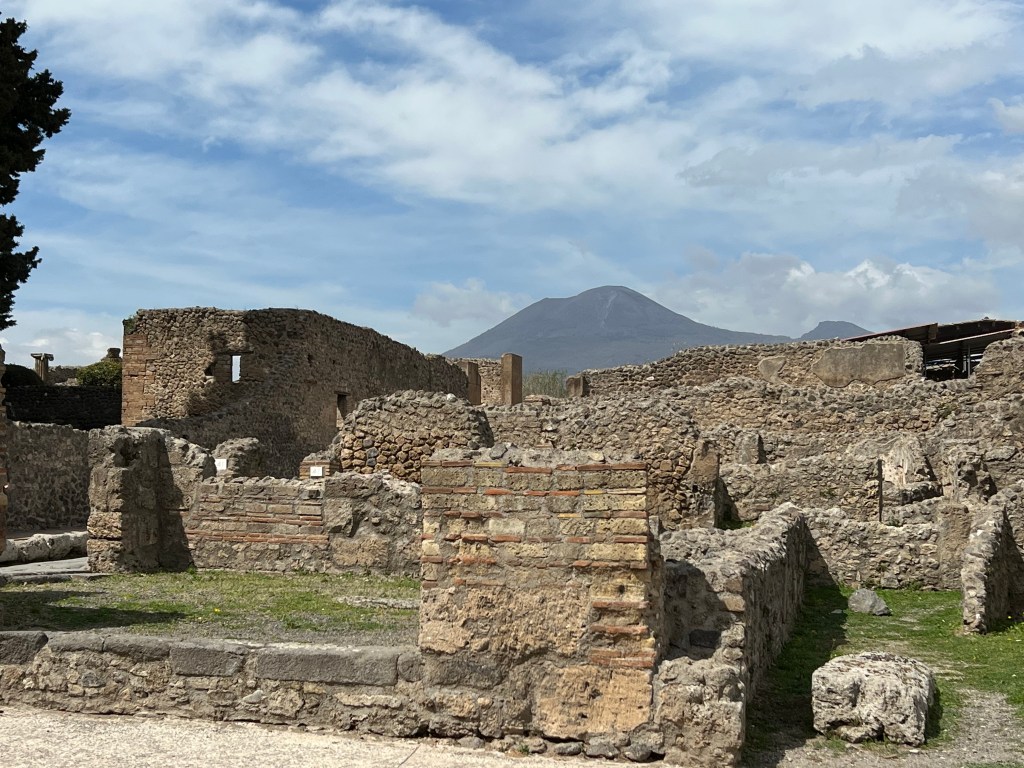
In 17 years after a major earthquake in 62 AD destroyed much of the city, Rome facilitated a re-building that included running water, toilets, baths, steam rooms, theaters, gladiator fights, lavish villas and a bustling economy – a city with a comfortable lifestyle that was still being rebuilt when tragedy struck.
In 79 AD Mount Vesuvius erupted in one of the most catastrophic eruptions of all time. While it had erupted many times before this date, little notice was taken as small earthquakes 4 days prior were thought to be insignificant. The eruption ejected a cloud of stones, ashes and volcanic gases to a height of 21 miles. The spewing molten rock and pulverized pumice as well as poisonous gases rained down on Pompei ultimately burying it 20 feet deep after 2 days of eruptions. Some did escape early on in the eruption’s first day.
Early Pompei was a major trading port where the city dwellers enjoyed a lively, sustainable lifestyle. Rich merchants traded goods from all parts of the world at that time. Those visiting foreigners could also freely enjoy the pleasures of the flesh by following particular markers on the streets and likewise upon certain buildings. More on that further on in this story.
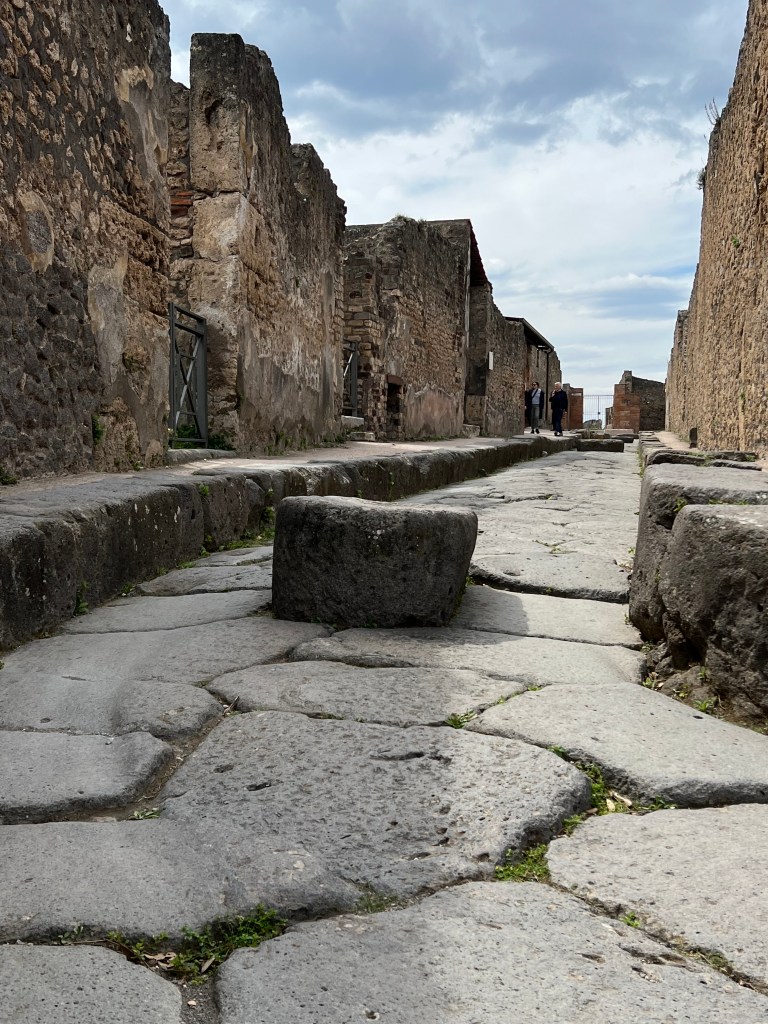
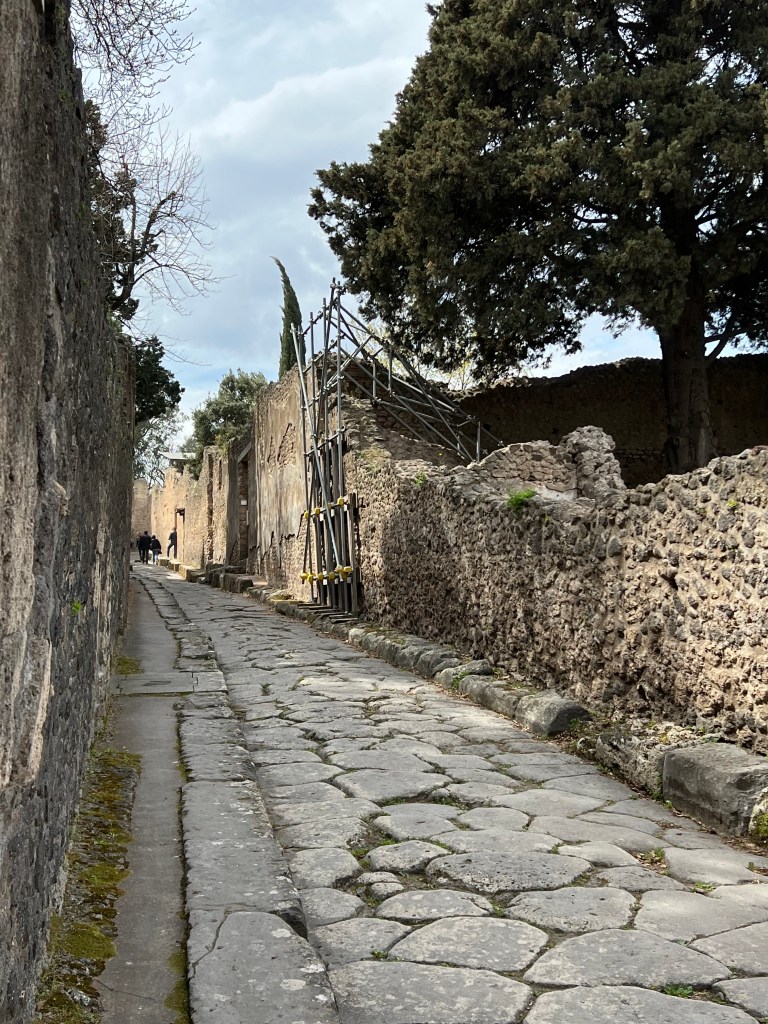
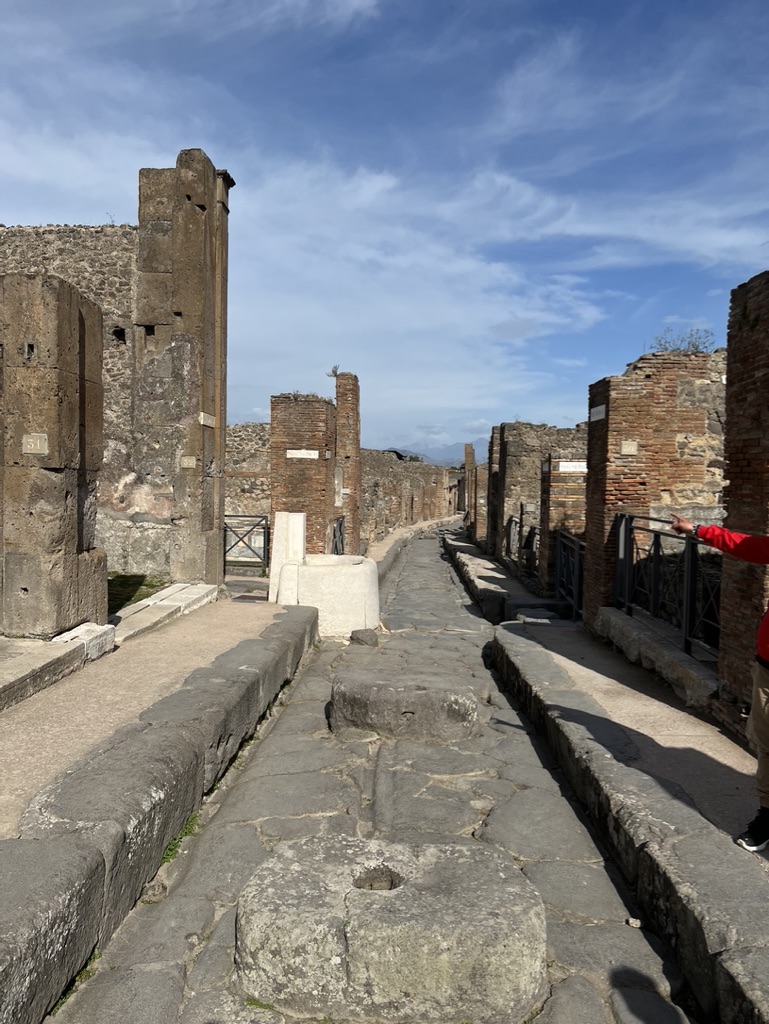
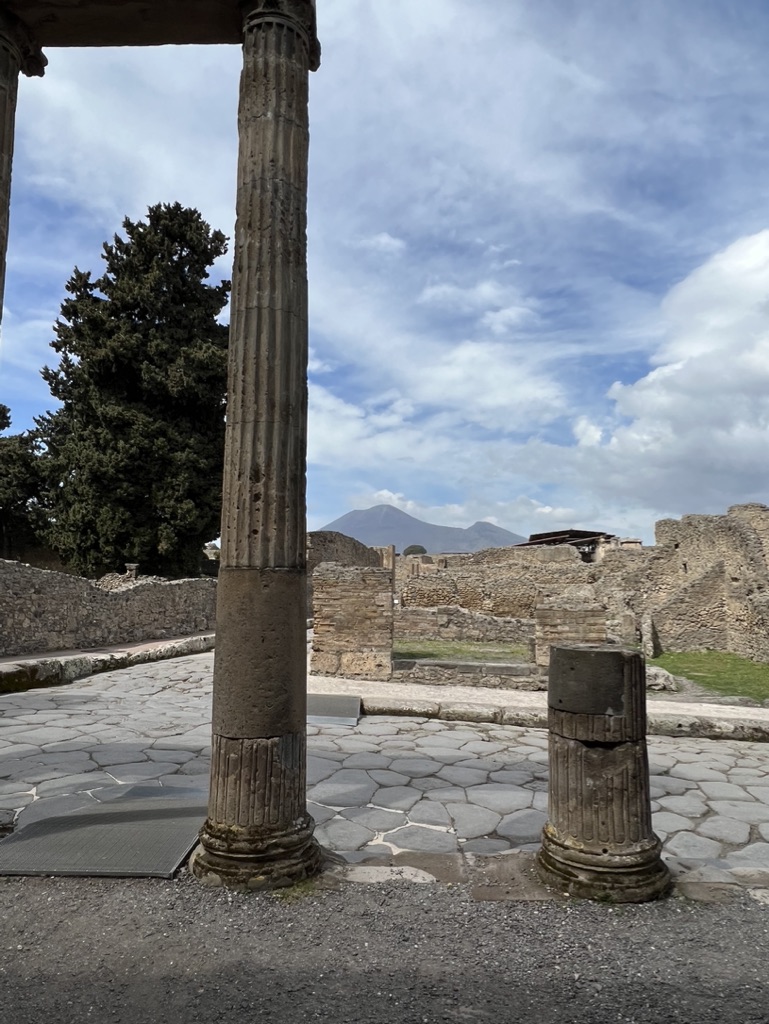
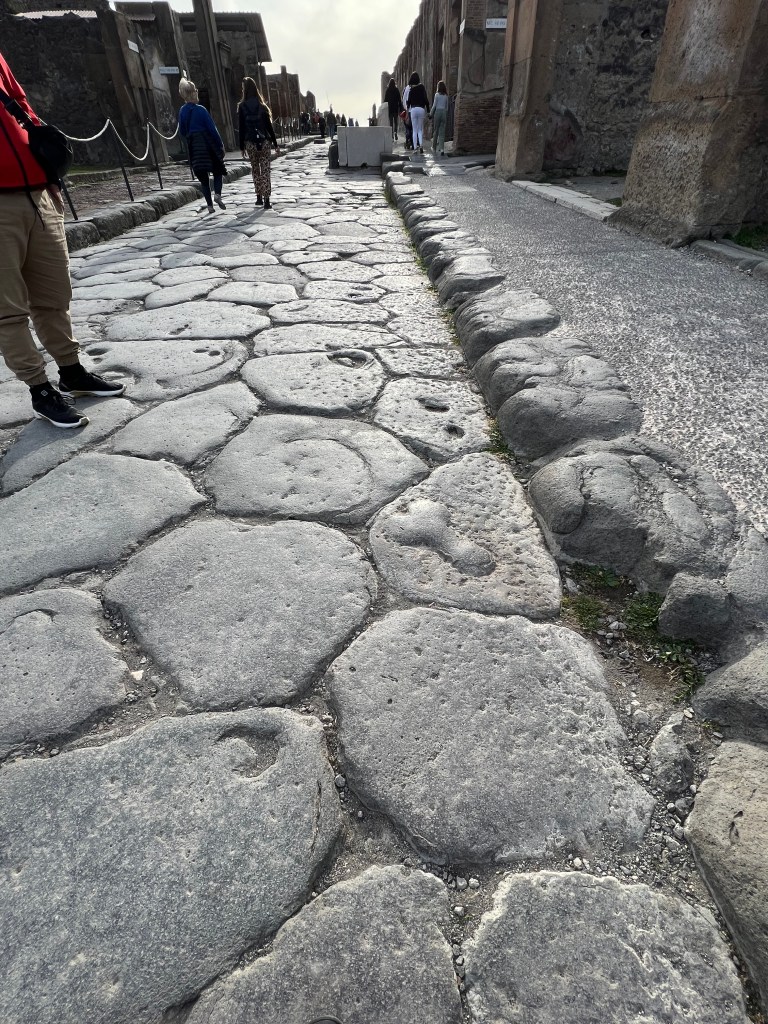
One of the first things Sasa pointed out were the stone streets which were meticulously constructed of lava rocks, carefully cut and fitted to the roadways. Very visible are the ruts caused by the wagon wheels as they traveled upon them.
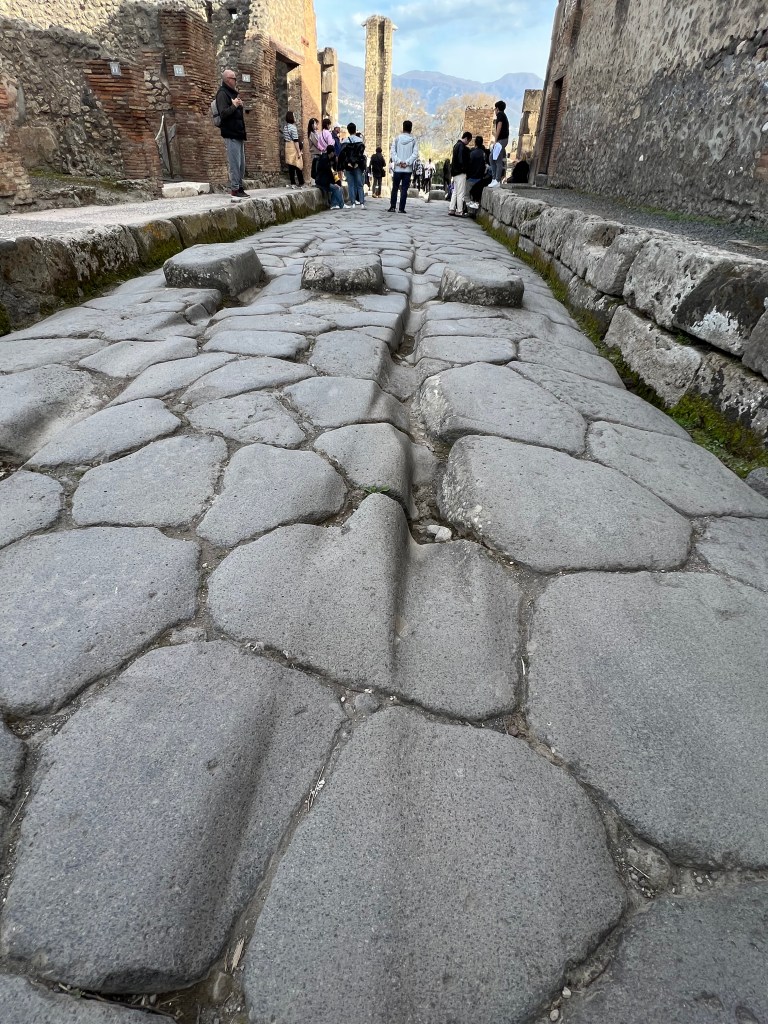
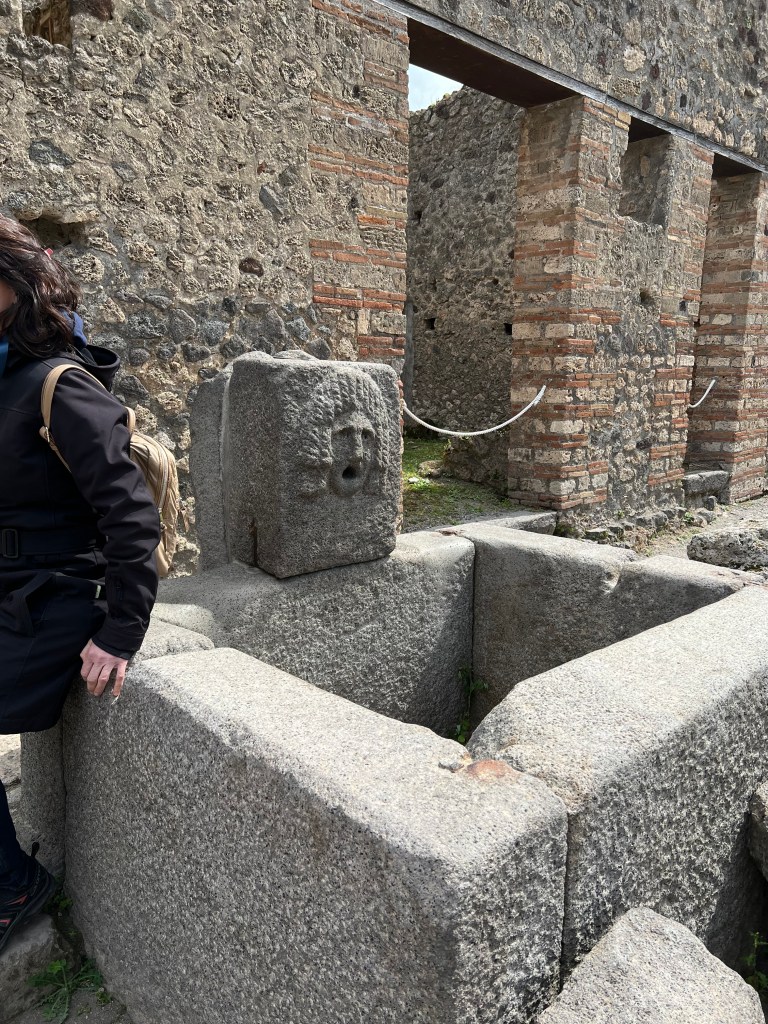
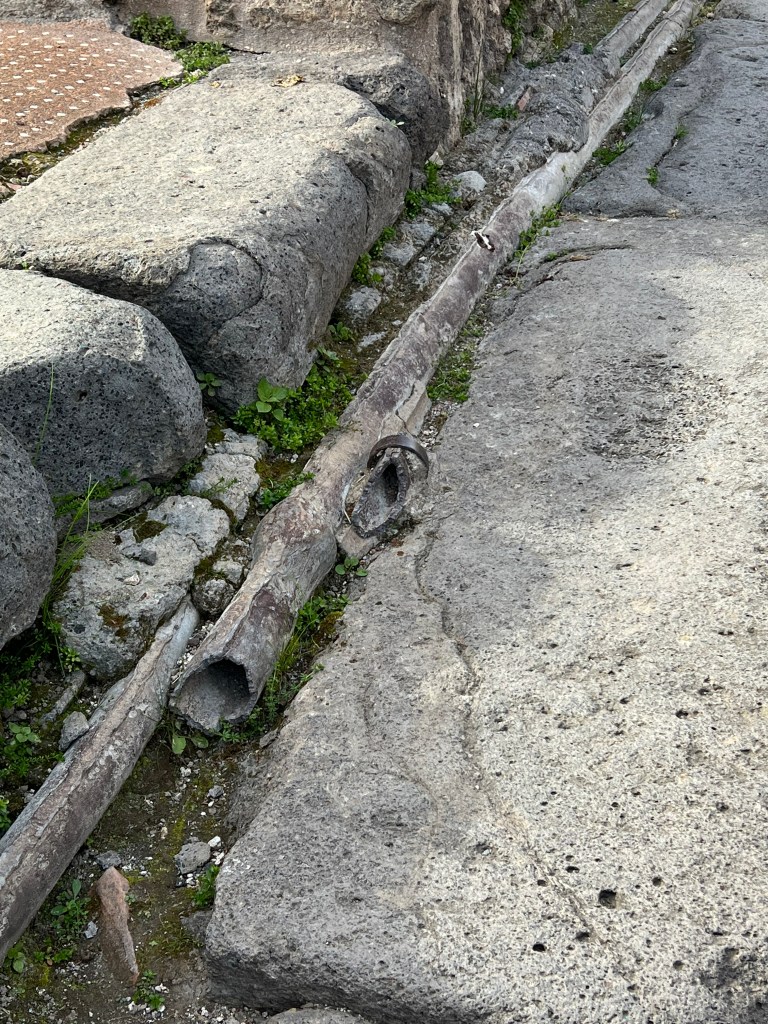
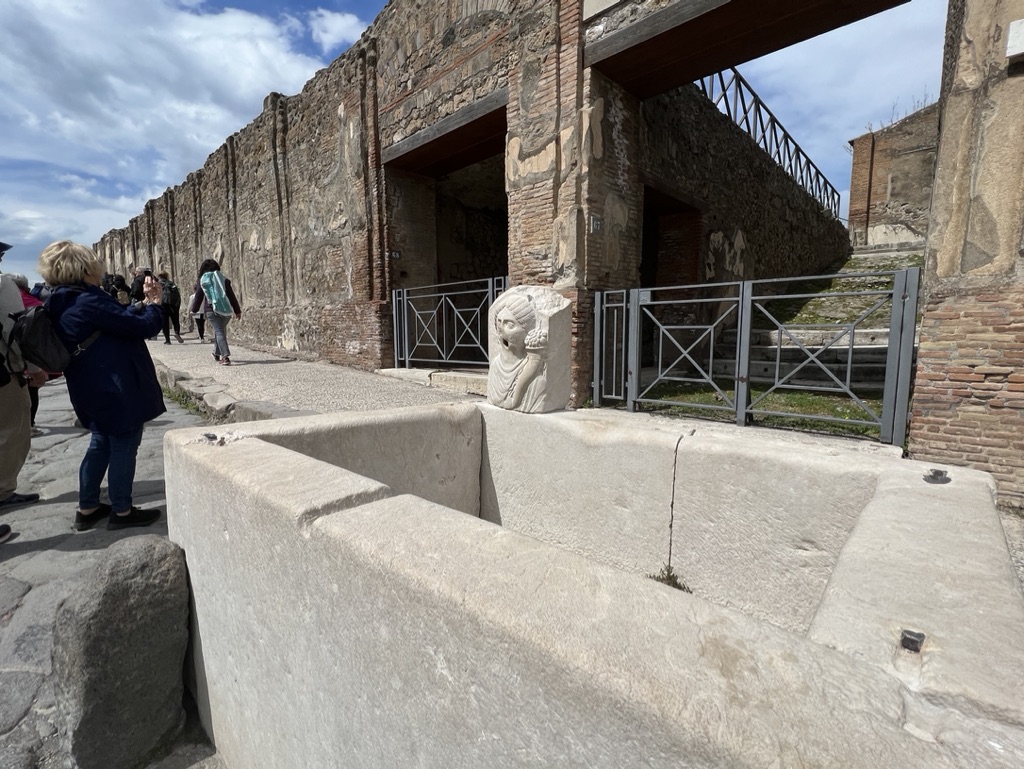
Sidewalks lined the streets and periodically large flat stones crossed over the streets; the precursors of our crosswalks. He revealed that those were stepping stones as the streets also acted as sewers. It sounds disgusting, but there was running water and periodic water fountains in the city streets, which provided water flow to carry away debris and waste. Being sloped, the streets all drained toward the sea, where, supposedly, runoff emptied. I did some investigating since then and believe that the city also did have an underground drainage system which helped control the rain fall and possibly some of the sewage drainage. The Romans built a water system bringing water via aqueducts from the hills and by cisterns that collected rainwater. A part of the system using 6 meter (19+ feet) tall towers controlled water pressure where tanks atop the towers were filled with the water coming down from the aqueducts and then down from the towers, under pressure, filling the fountains and water pipes into homes. This was the early forerunner of running water in our homes which fed indoor fountains (can you just imagine and hear the calming sound of water spouting into a fountain?) and may have been used to flush waste from toilets. The streets were routinely flooded to keep them clean. The water was carried in lead pipes, which I can imagine may have had some significant health consequences.
Still, the stepping stones over the streets probably spared sandals and togas from getting soiled from whatever may have been flowing in the streets.
We also learned that at least some second story homes had toilets. In my reading, since, some toilets were also on first floors which emptied into cesspits. I would imagine that the water system then carried away the waste.
While we did not see them, communal toilets were common in ancient Roman times. It was told that while sitting around men often discussed business and possibly other important matters of the times (like what to do if Vesuvius blew its top?). Not a time or place to be caught with your pants down!
Bathing in ancient Pompei was a public activity not private. One of the only buildings that had its roof intact (which was not the case for most of the buildings) was a bath where one area was for women and another for men. One room was a large steam bath for the men.
Walking along those ancient, well preserved streets, one can admire the engineering and thought the Romans put into building what had to have been a modern city of its time. The eruption of Mt. Vesuvius and resulting burial of Pompei, frozen in time, allows us the opportunity to discover exactly how the people lived over 2000 years ago.
Among what we learned were the kinds of shops from that era. Buildings that were shops were recognized by front thresholds bearing grooves. These they believed were for sliding doors leading into the businesses. We visited bakeries where stone mills (still standing) ground the grain into flour and wood fired ovens were used for baking. There are accounts where baked bread was also found in the excavations of Pompei (probably a bit over-baked).
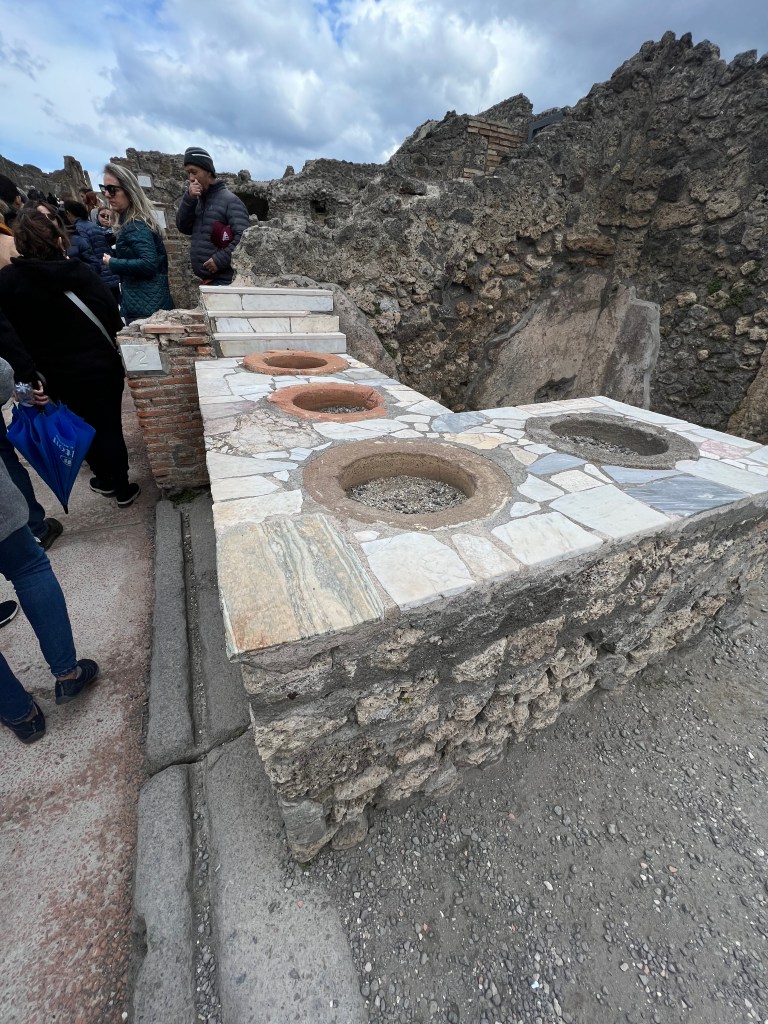
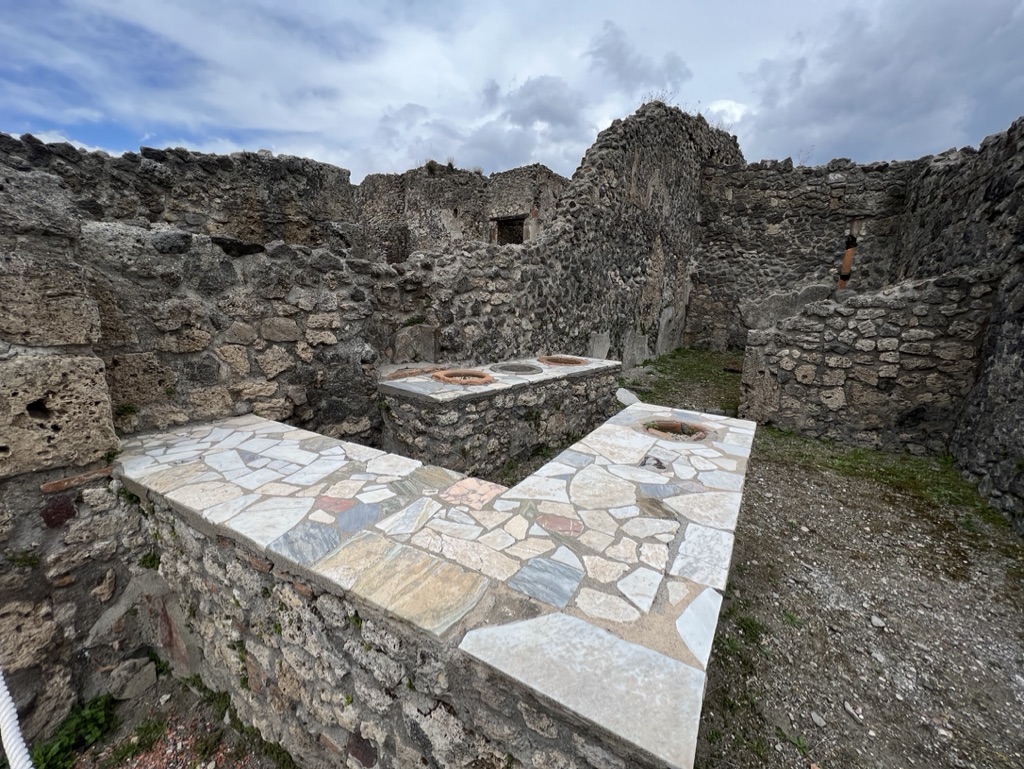
One type of shop featured stone counters with openings that held clay pots. The pots may have contained foods like soups, fish, vegetables and where customers could order and take out to eat. Interestingly, these are the origins of fast food restaurants.
Shops also would have a room in the back where slaves would live.
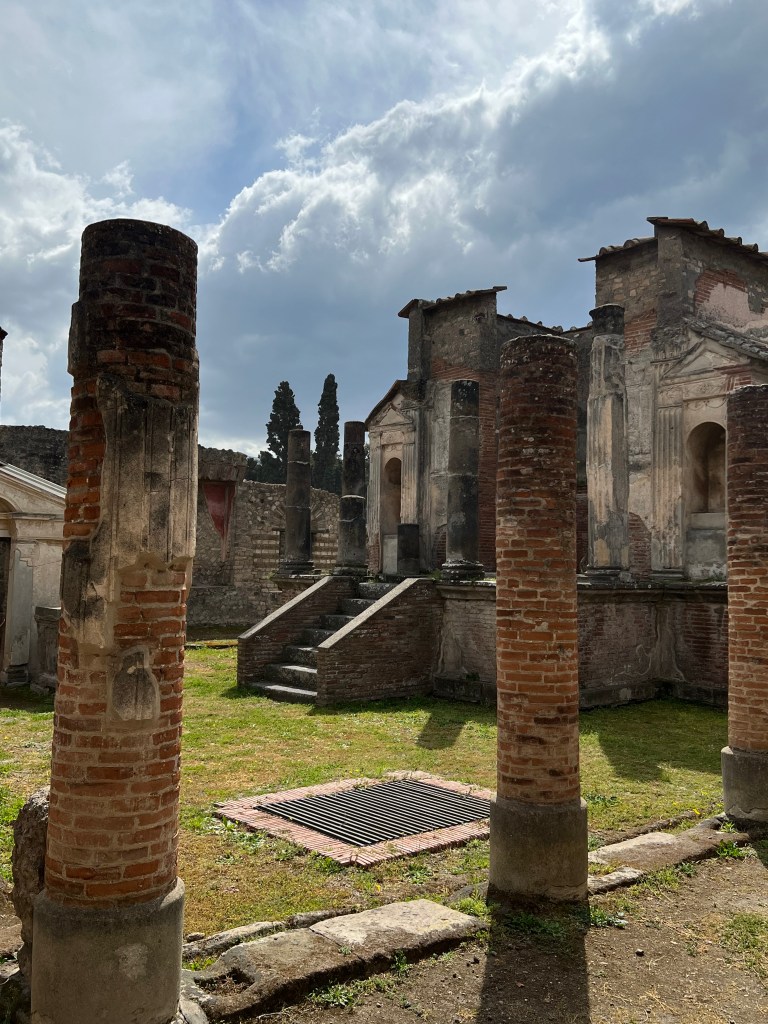
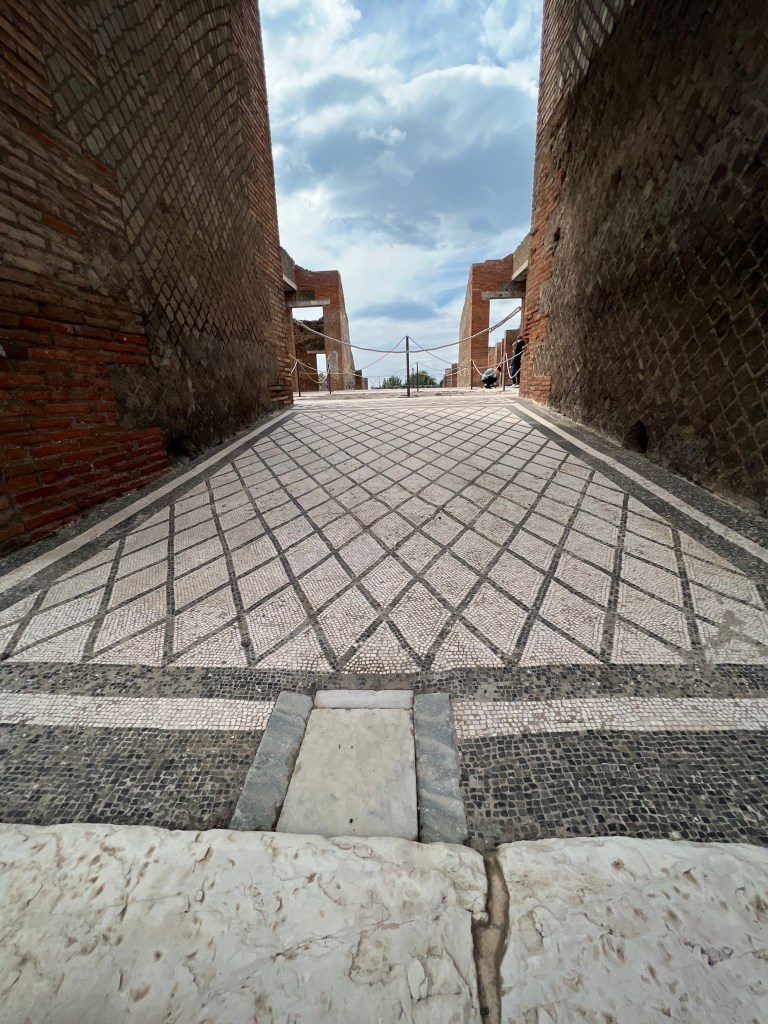
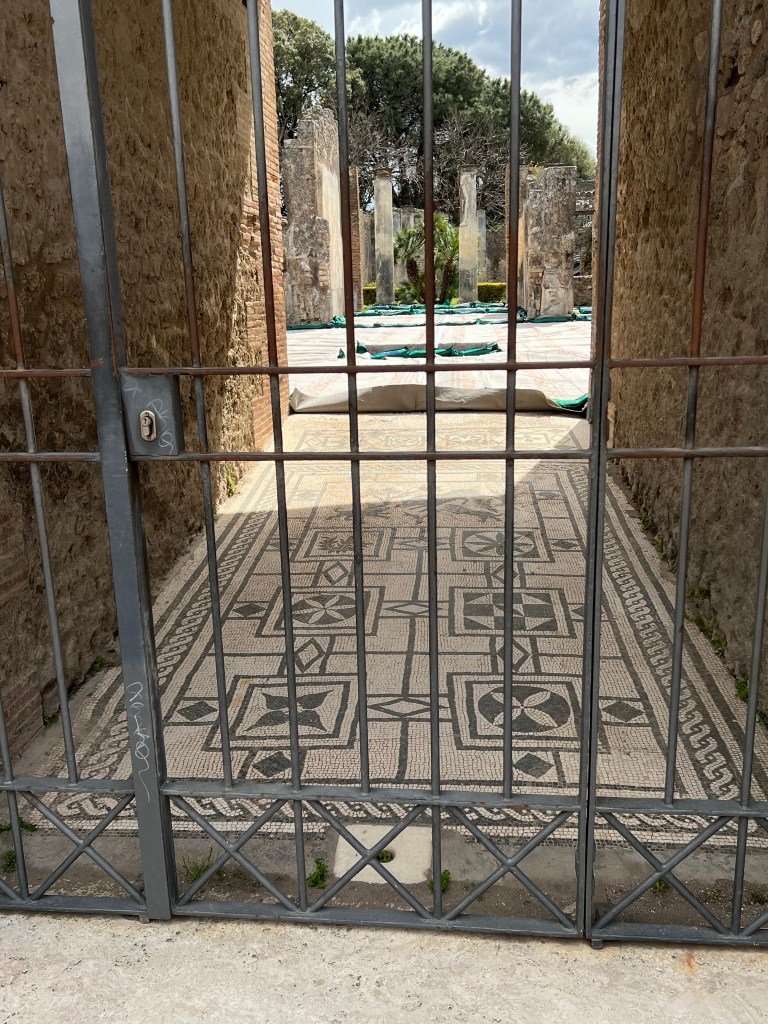
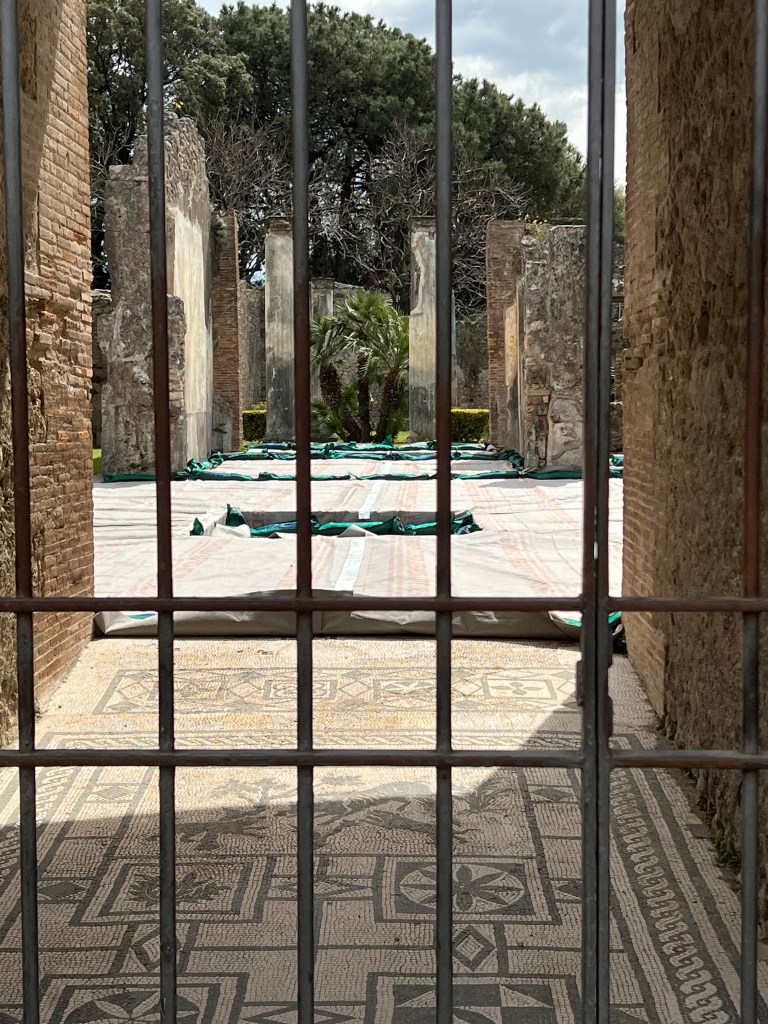
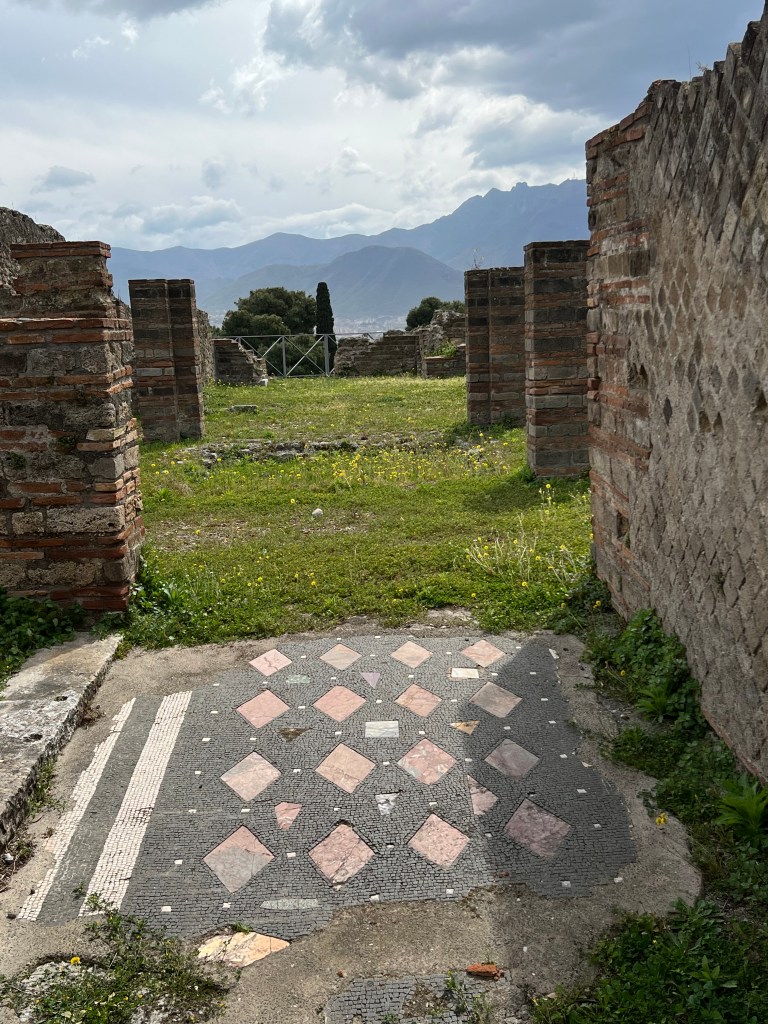
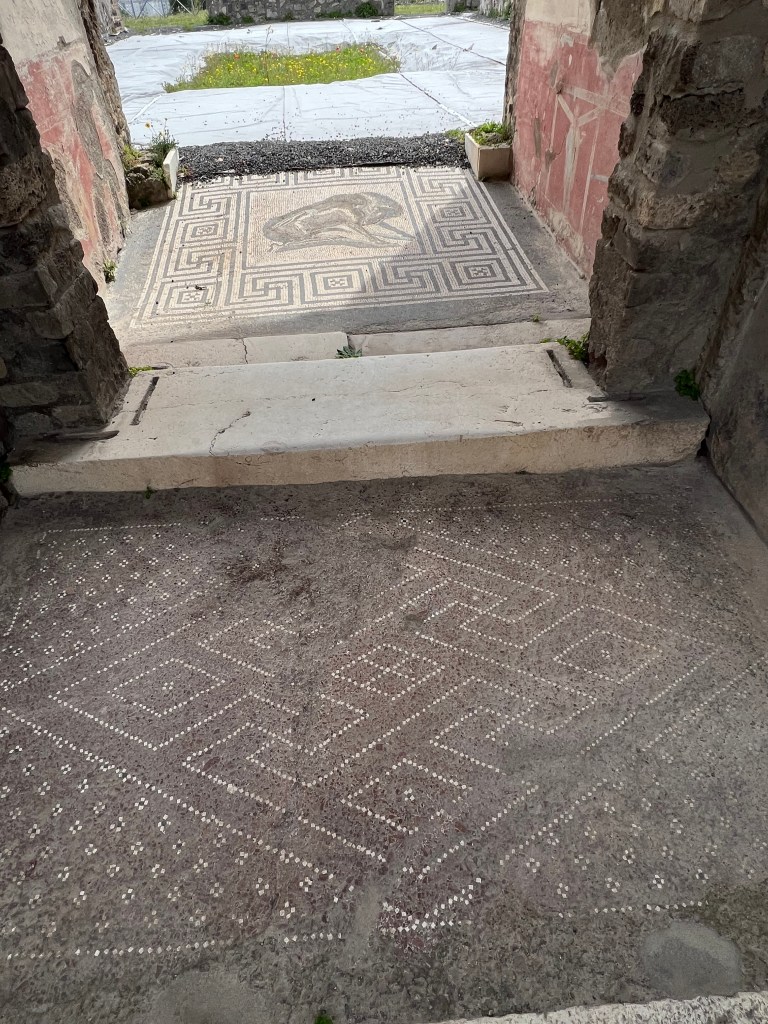
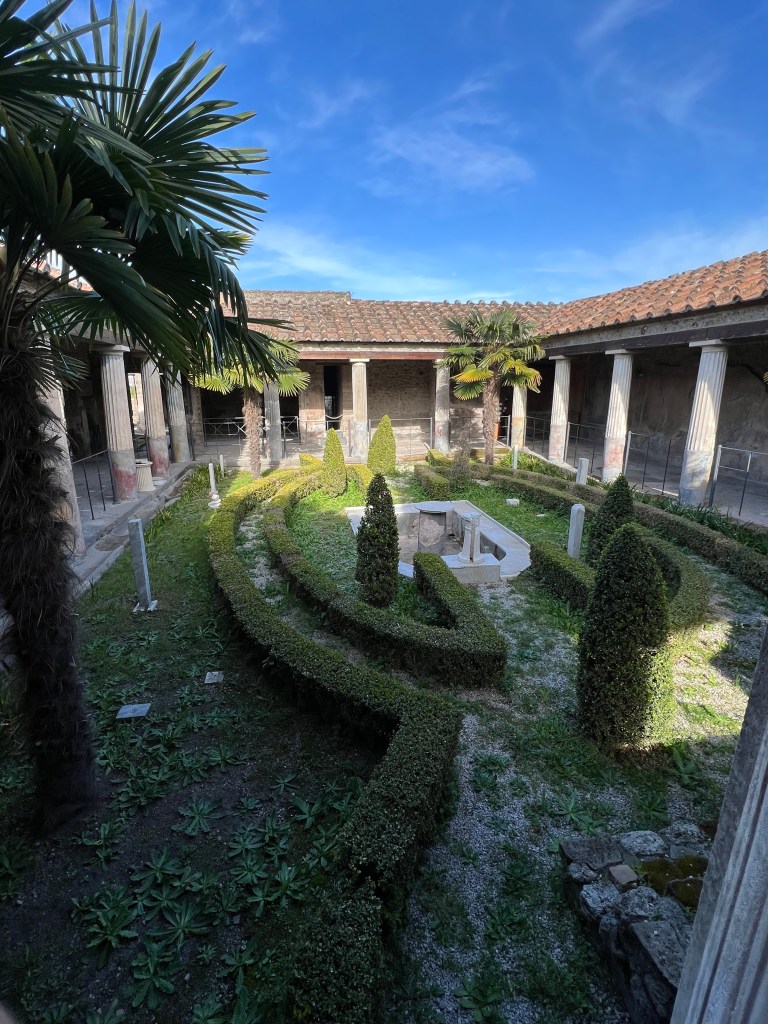
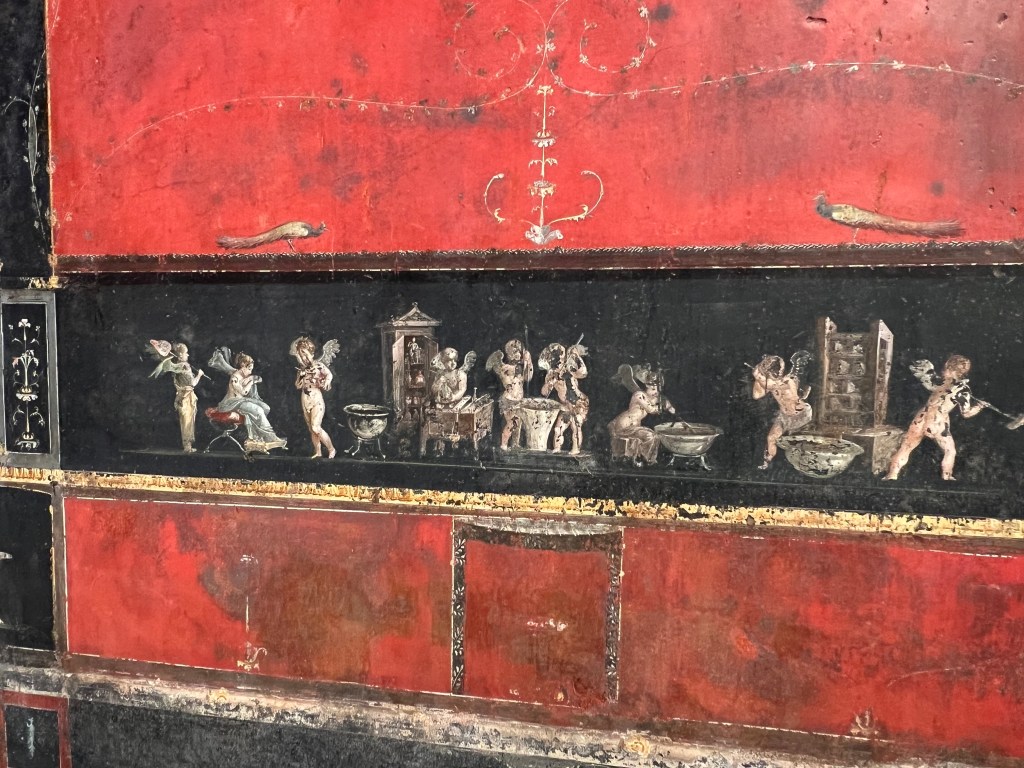
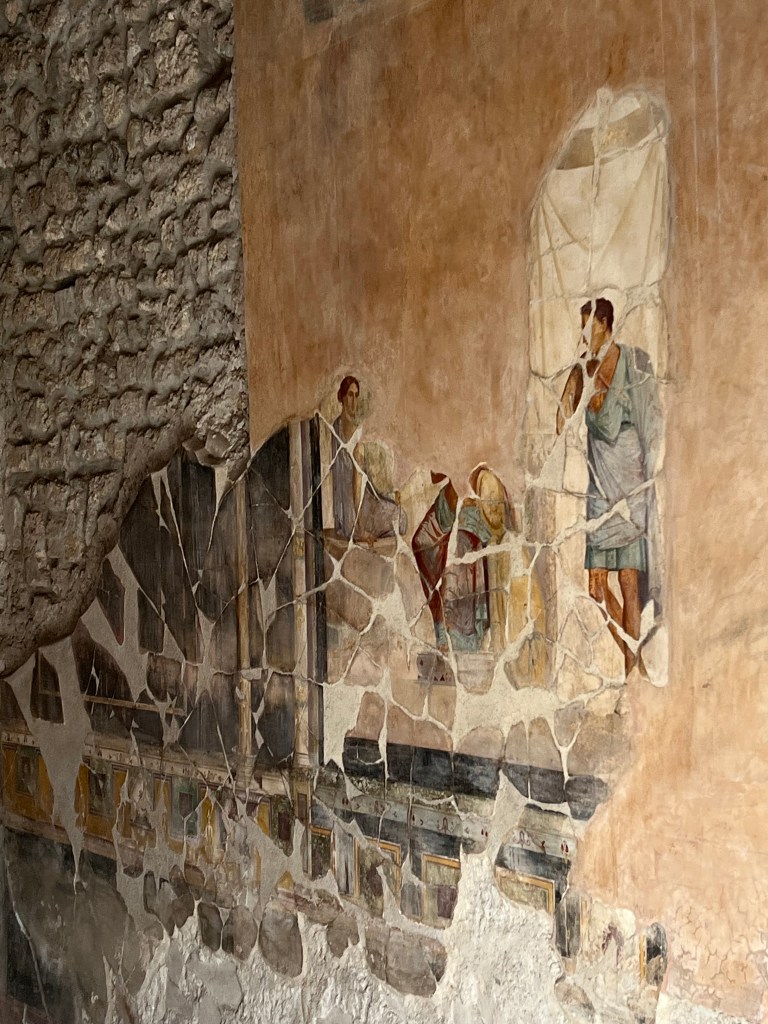
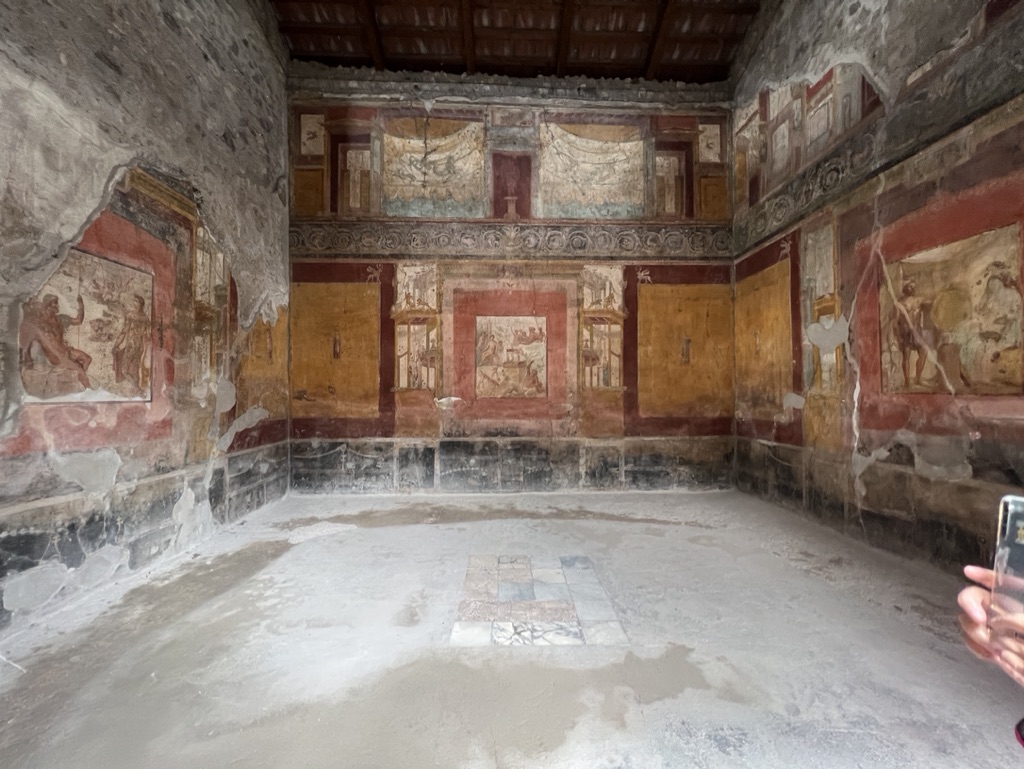
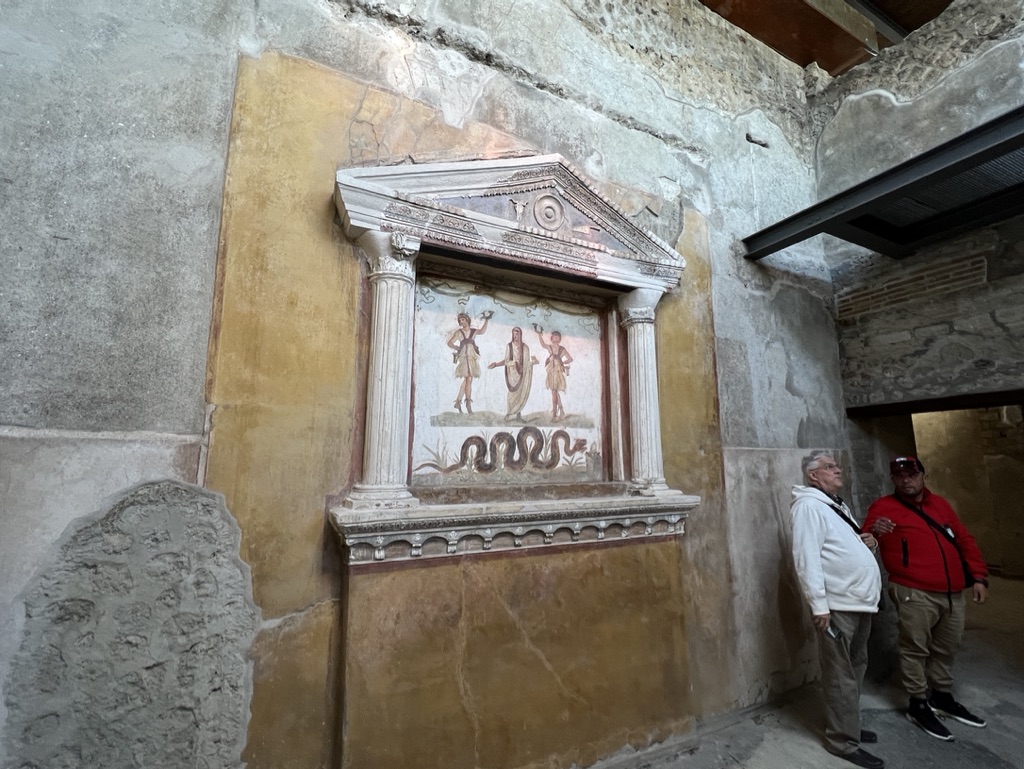
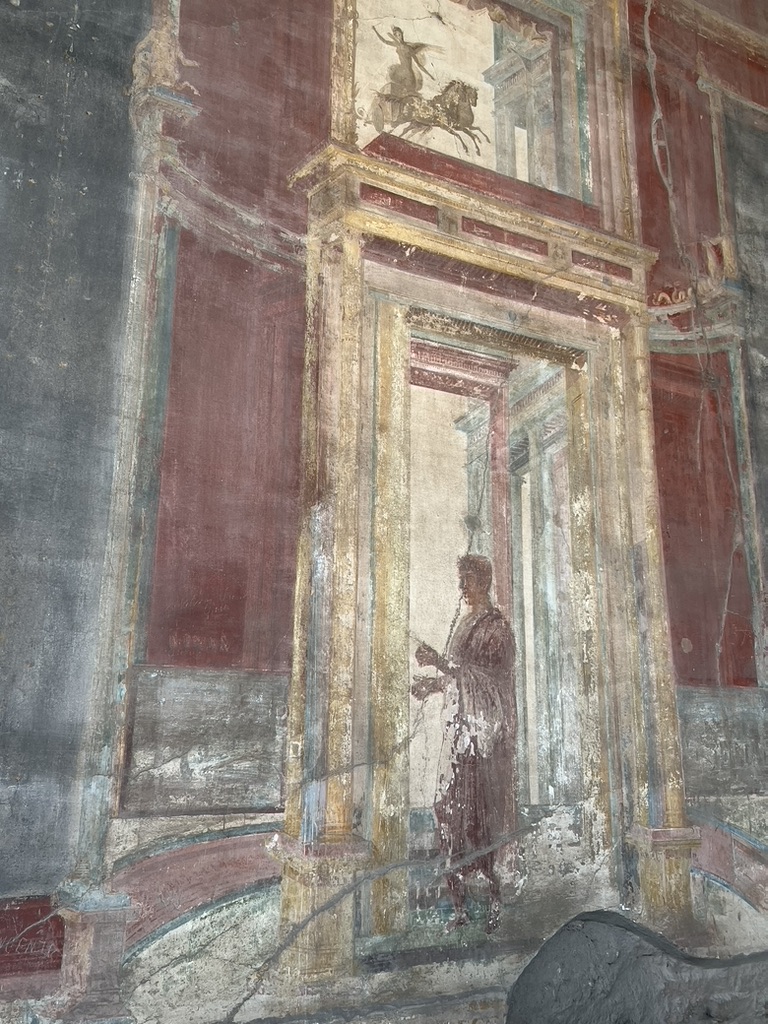
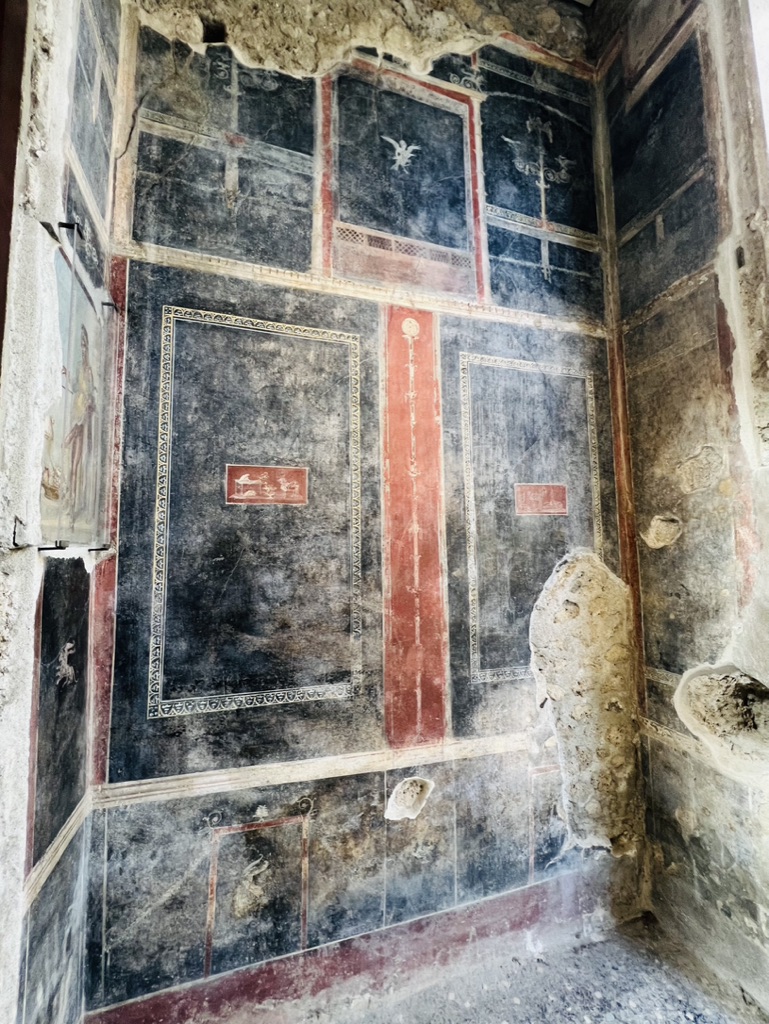
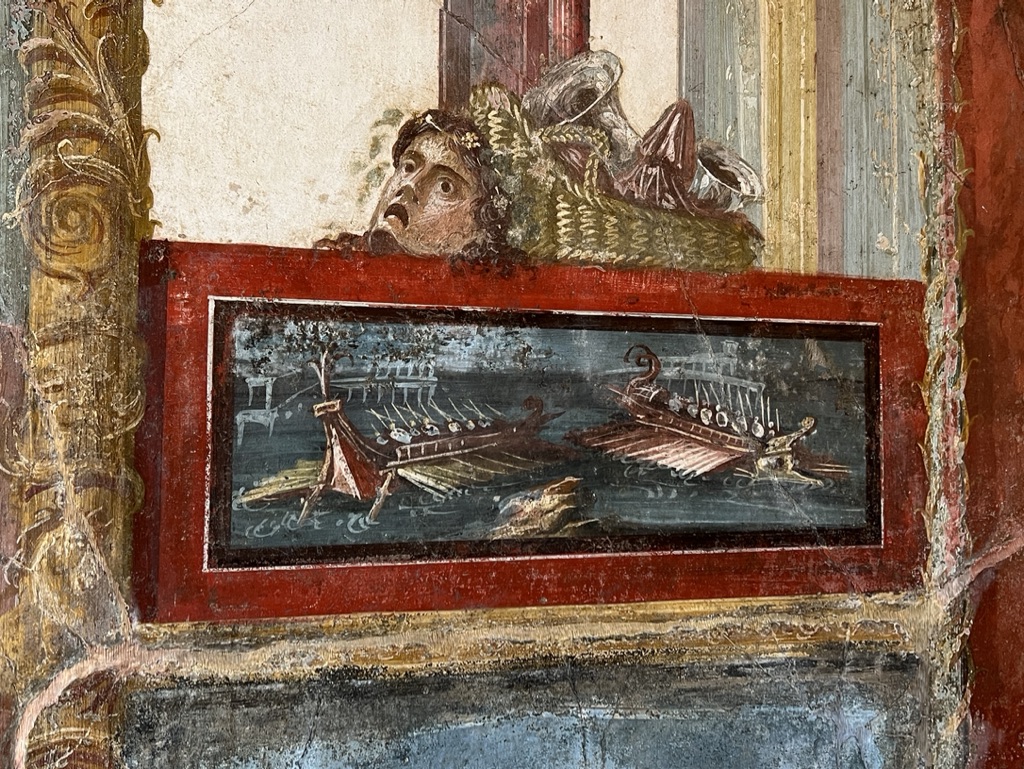
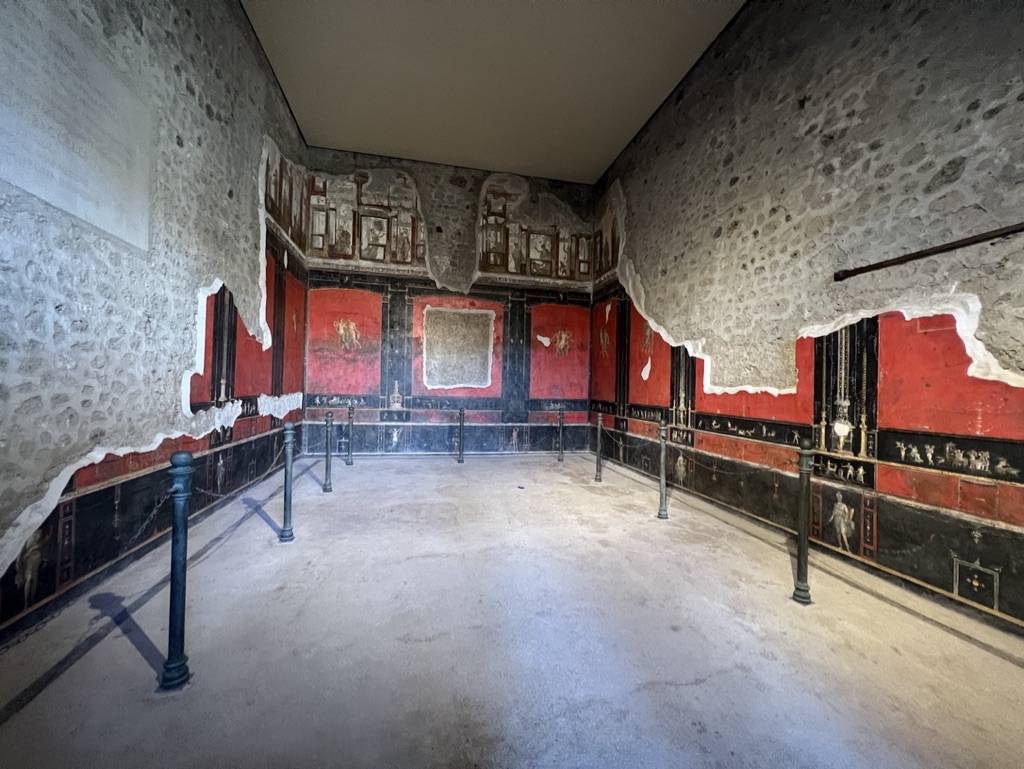
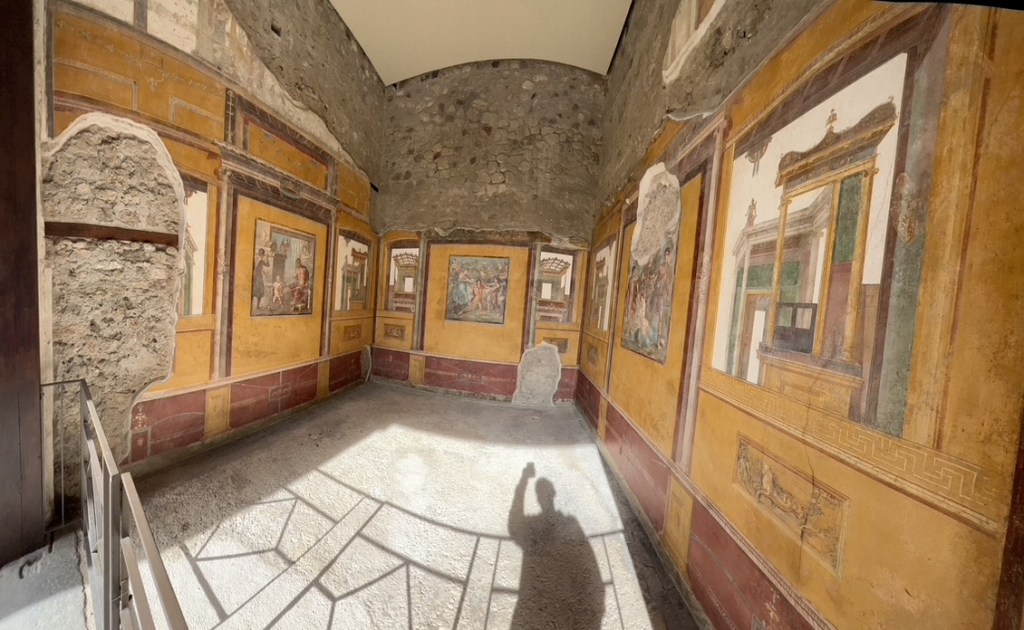
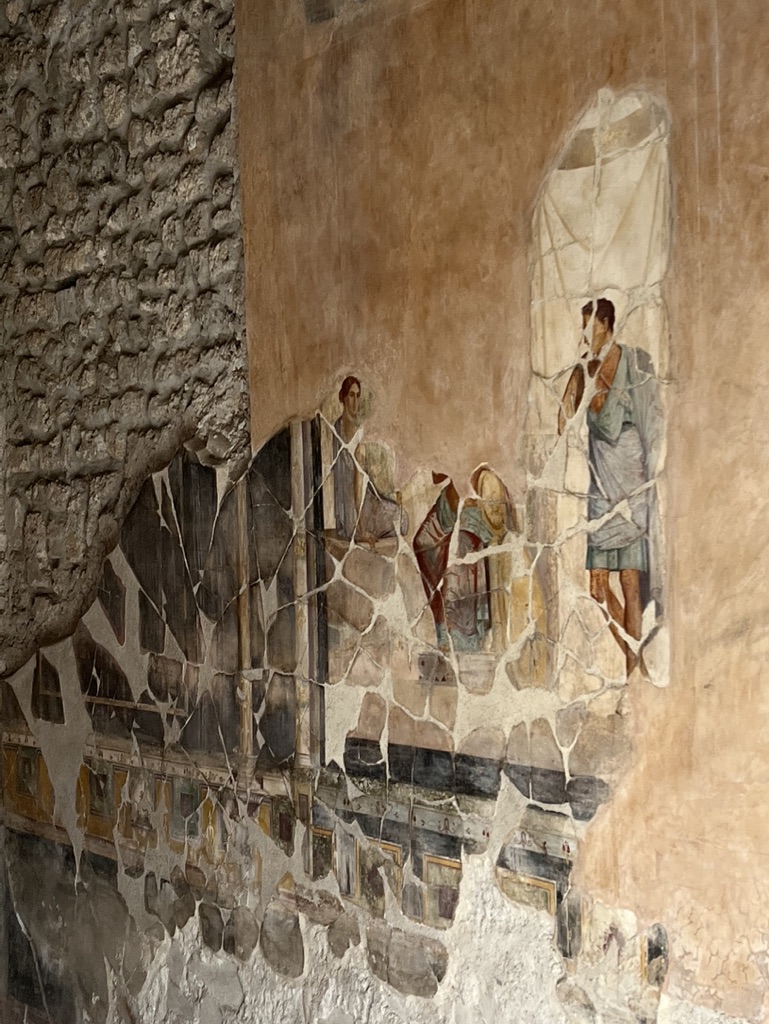
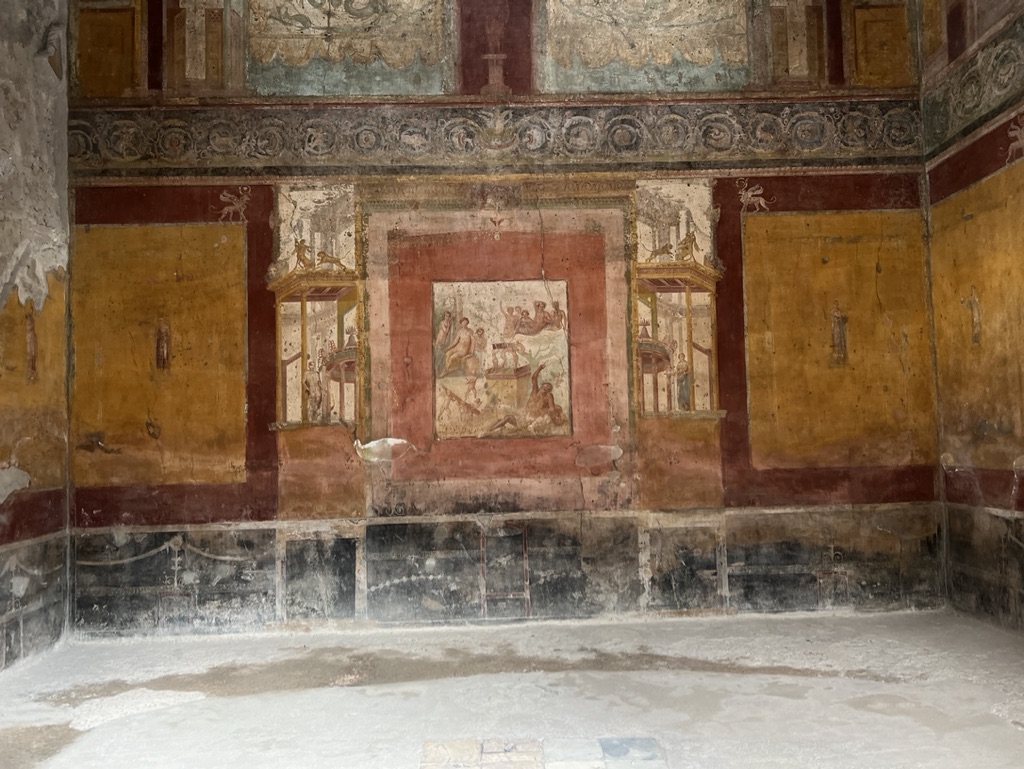
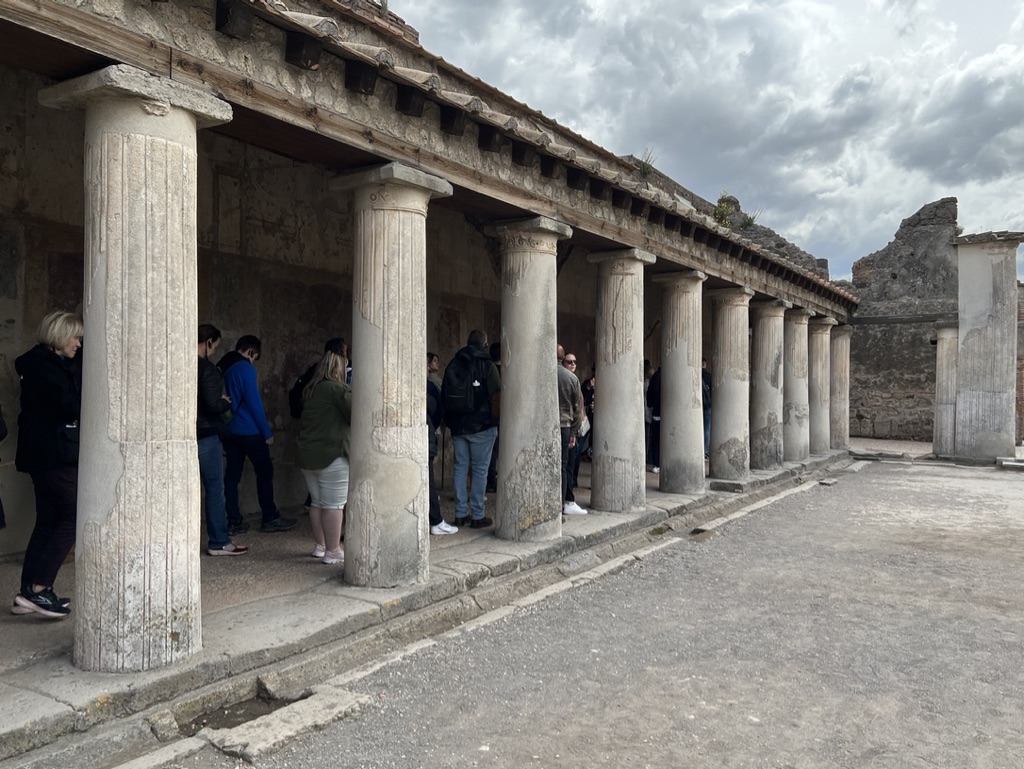
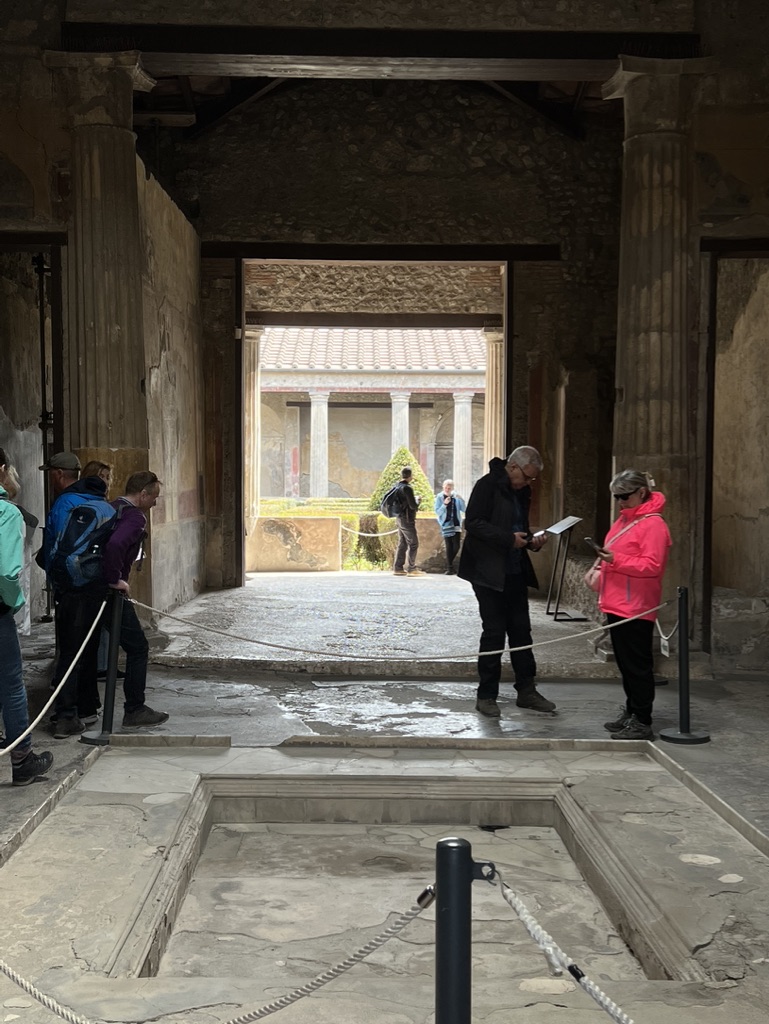
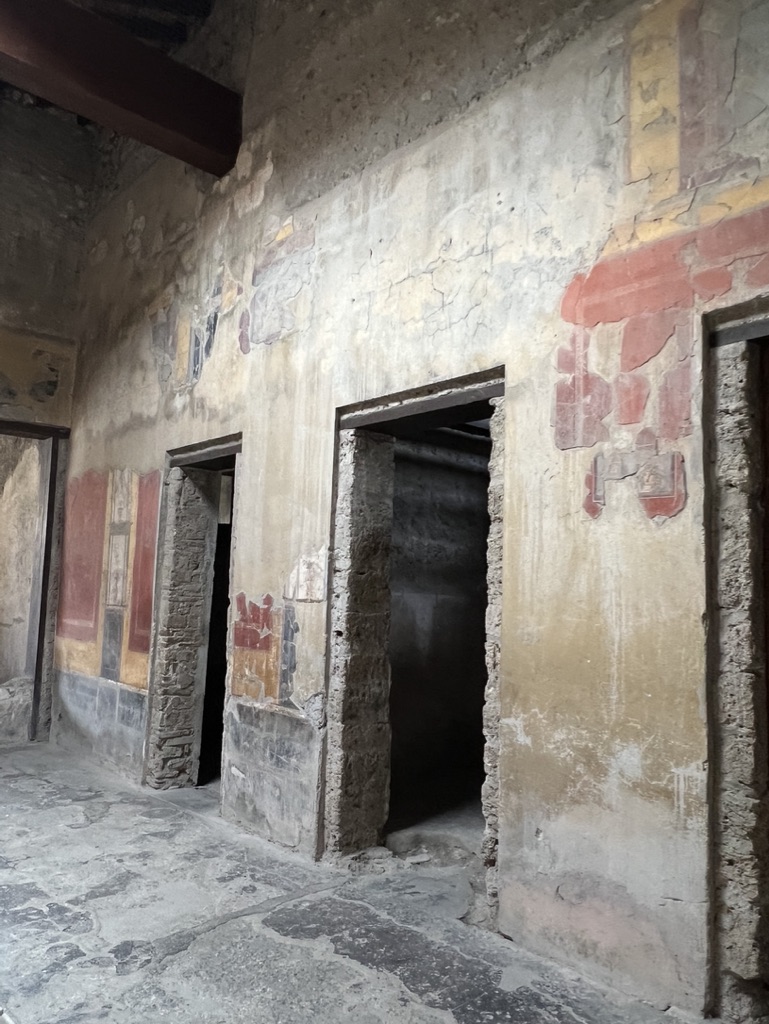
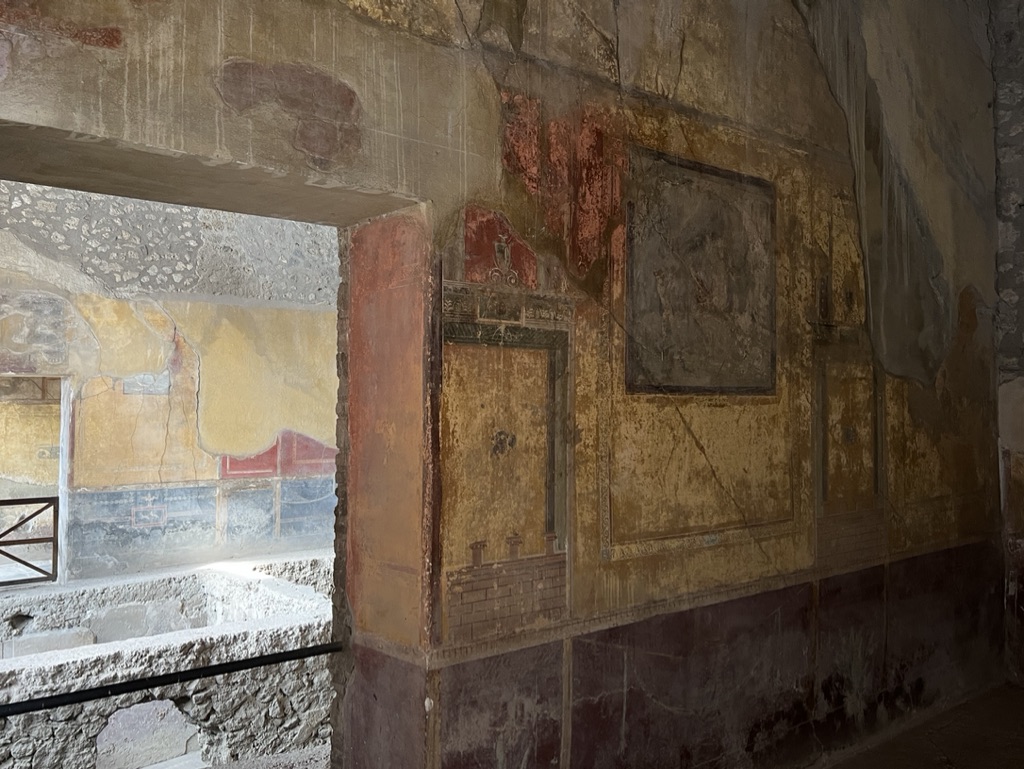
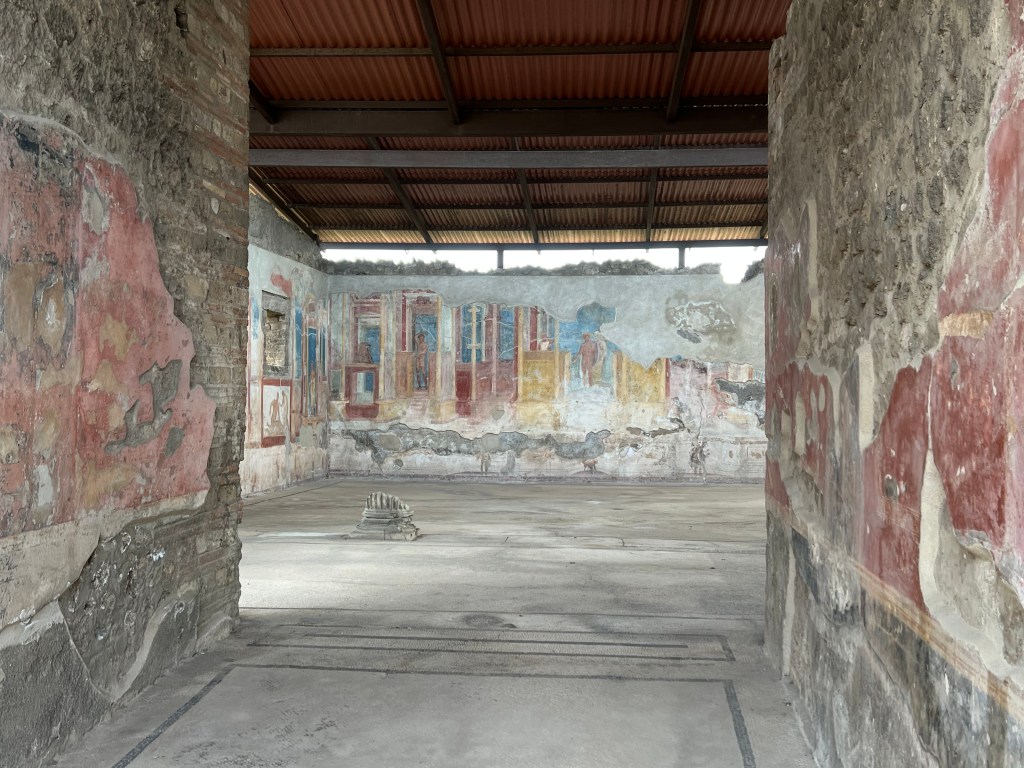
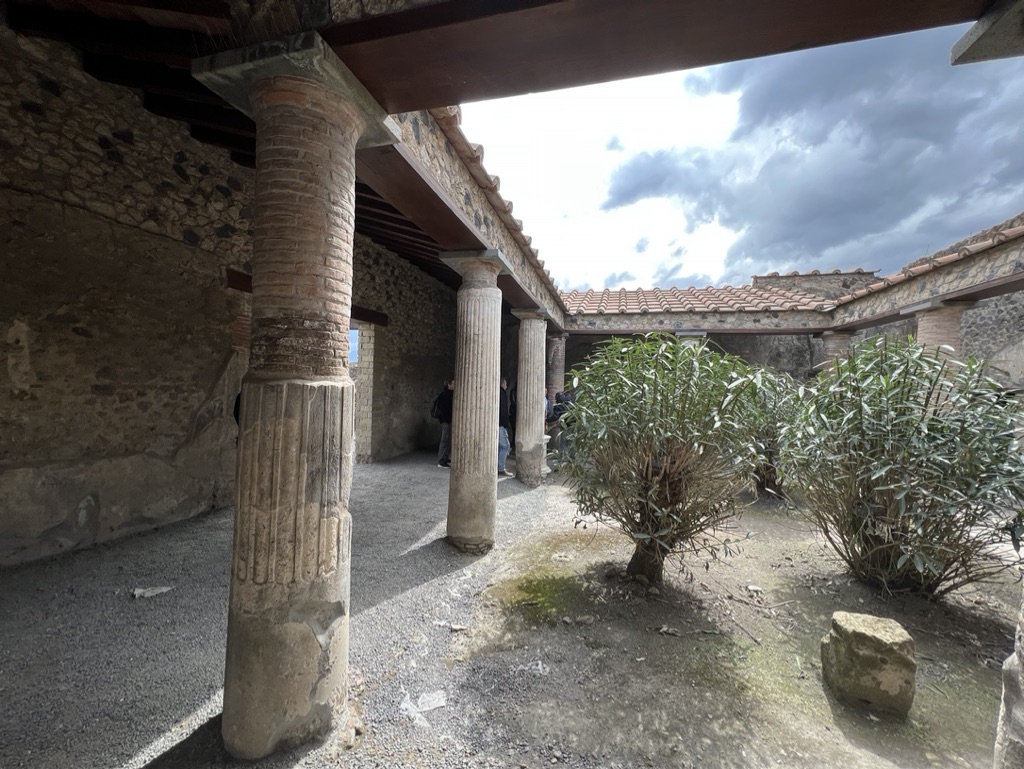
Lavish villas were also a part of our tours. Entering, most had intricate mosaic tile floor murals, which then might lead into an open atrium with a water pool or fountain as a central feature. It would have been a very welcoming entry into the home. Rooms led off of the atriums to other rooms. A major focal point of these homes of the well-to-do were the central gardens, many with fountains, open to the sky and bordered by columned walkways also leading into other rooms. Bright colors with paintings and frescoes decorated rooms as well as more mosaic floor tiles. It was pointed out that many floors and on some walls were small inlays of white marble. It is believed that they helped reflect light, especially helpful in the evenings when lighting was by candles or some sort of lanterns. It also reflected moonlight, which must have created a very soft light. Most homes also had shrines to whatever deity they worshiped.
The entries to several villas with mosaic floor tiles;
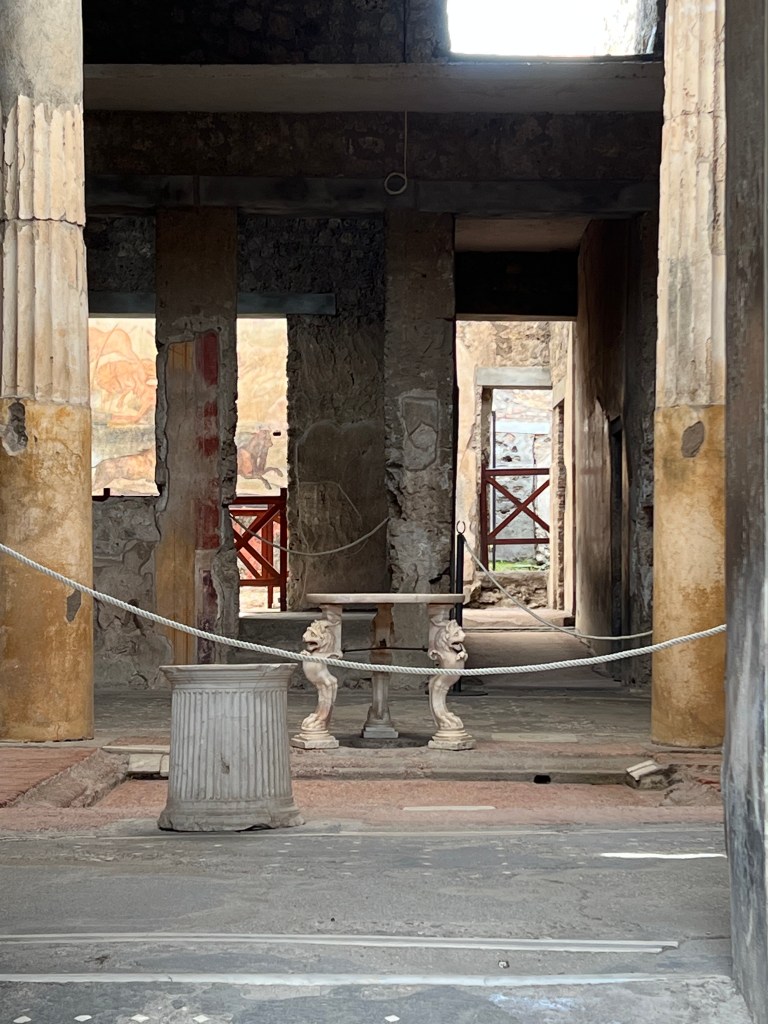
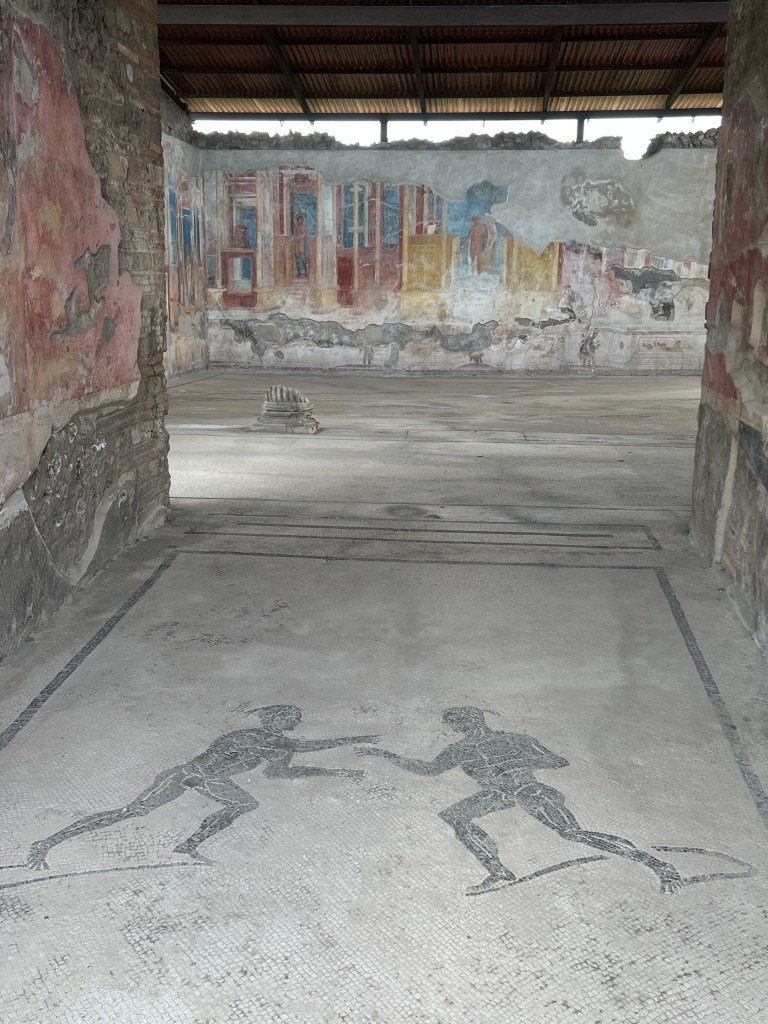
The more we roamed about in Pompei, the more intrigued I became. What you will see is a moment in time that is frozen. Time and centuries of progress halted any improvements or changes to this bit of history.
We did see some of the bodies that were also frozen in time. Excavations of Pompei began in the 1700’s and continue to this day. All attempts are made to unearth more and preserve what has been uncovered. The bodies are actually plaster casts. The bodies decomposed in the buried ash leaving hollow casts which were filled with the plaster revealing the last horrific moments of life for those hapless people. Some were of families together in their final minutes; some in contorted positions unveiling their agony.
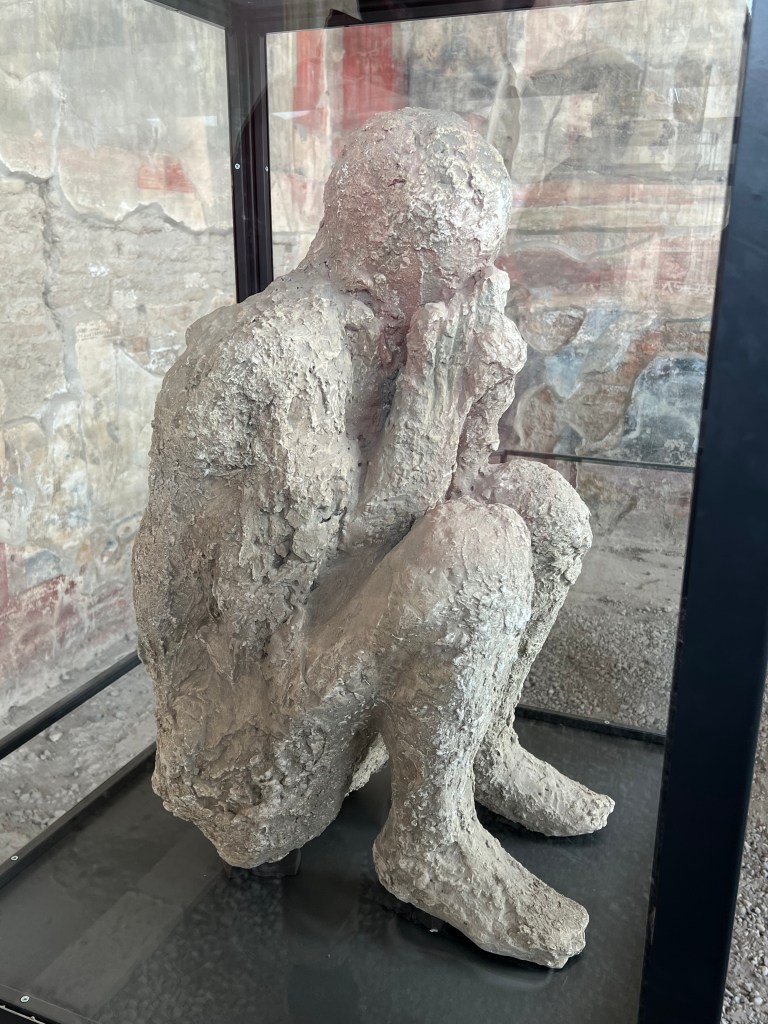
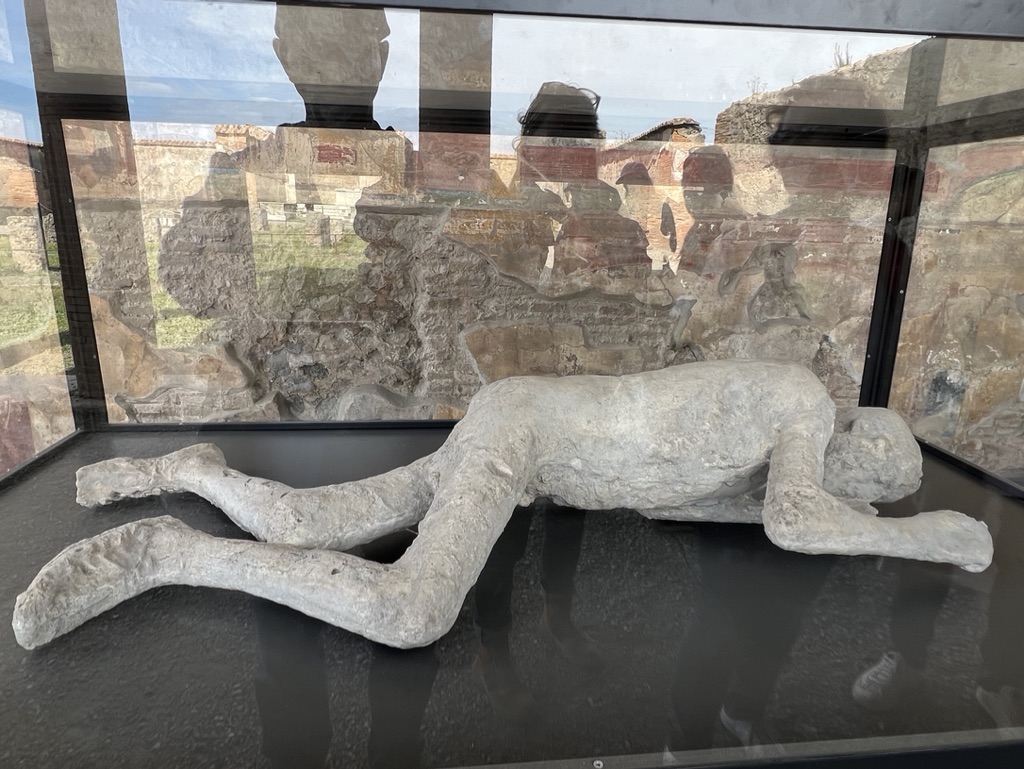
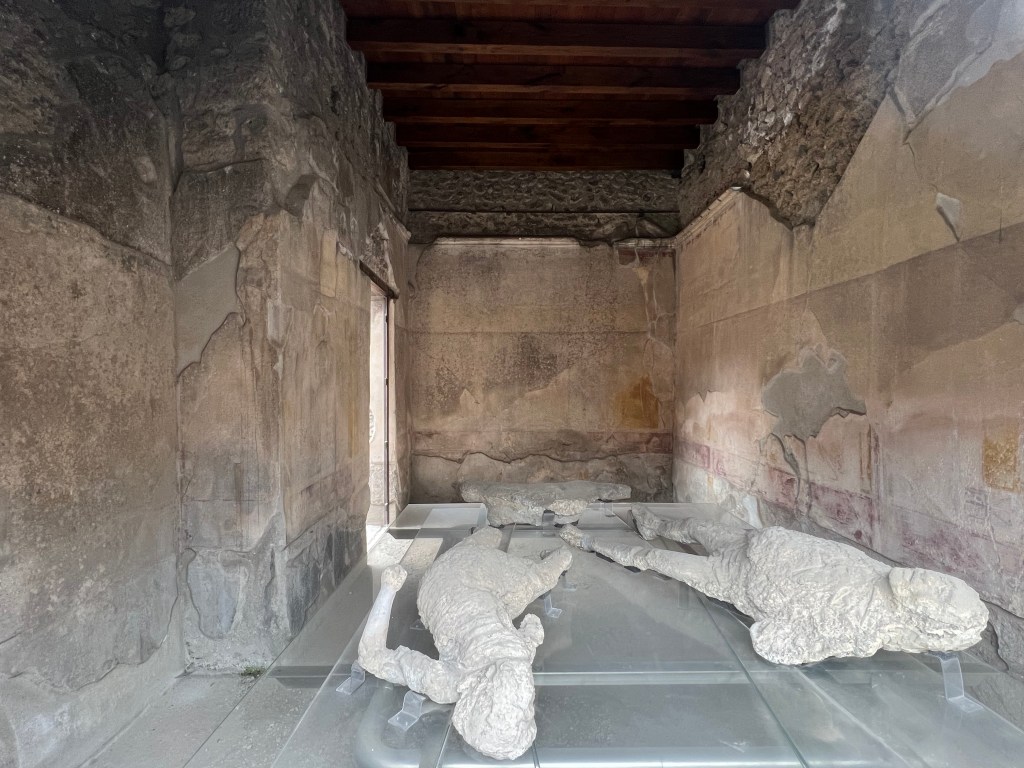
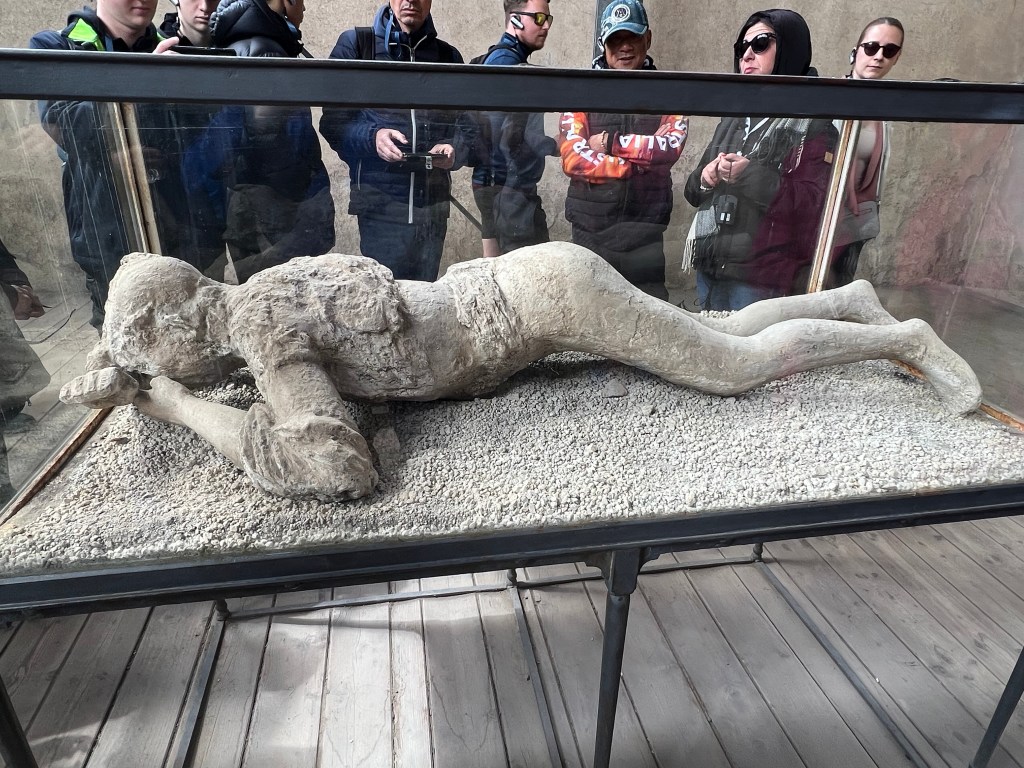
Late in the afternoon, Giuseppe arrived to pick us up. Again his exuberance literally glowed as he continued his communication with us on the way to our hotel. Arriving there, he surprised us with an Italian gesture that only he displayed while we were in Italy. I was somewhat startled as he unexpectedly took hold of our shoulders giving pecks on both cheeks. What an awesome display of his joyful and welcoming nature.
The next morning exuberant Giuseppe was at our service as he took us back to Pompei. He promised to come late that afternoon to pick us up.
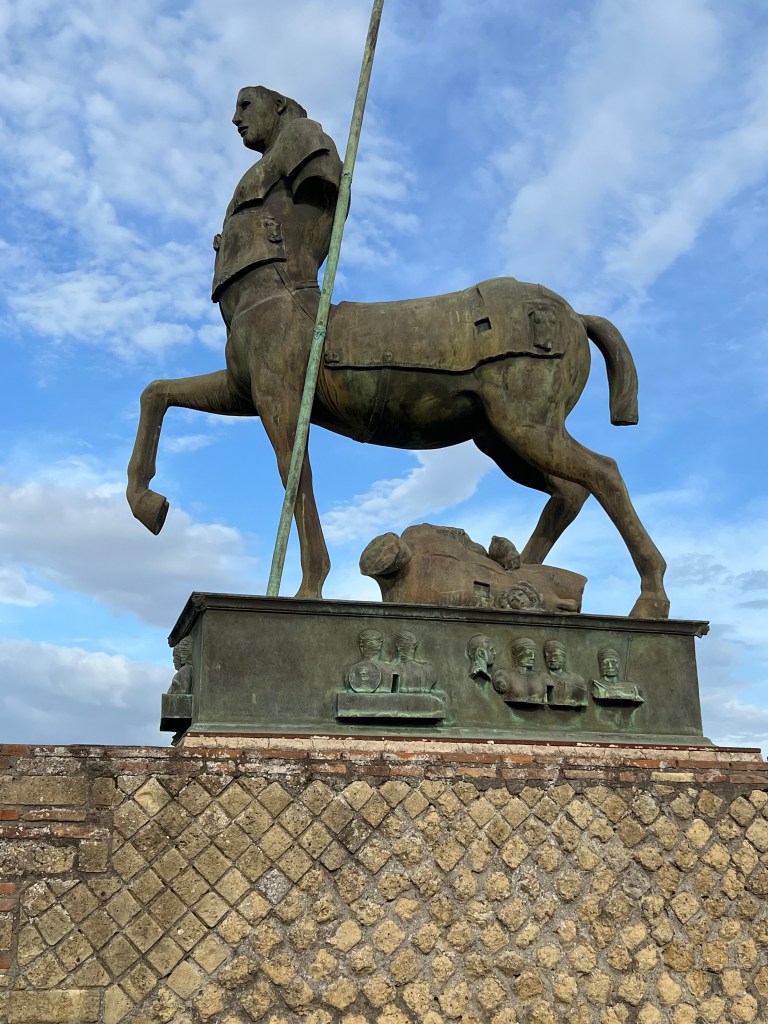
Our second day at Pompei was with a larger group that covered more areas of the city and presented with another’s knowledge and information.
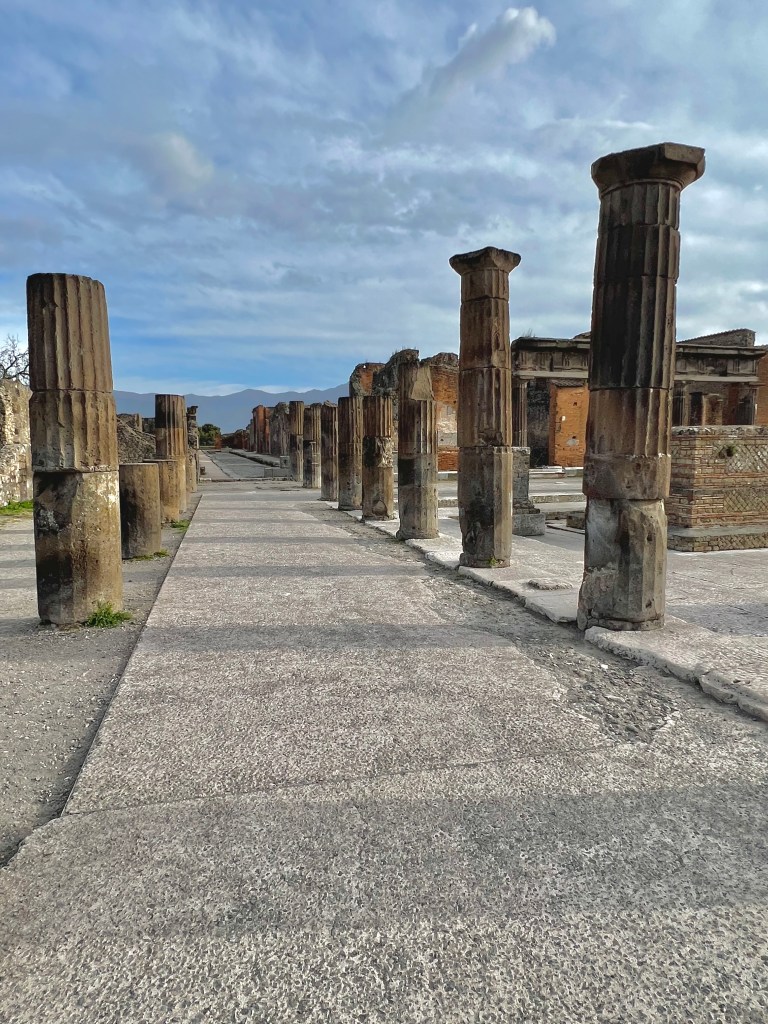
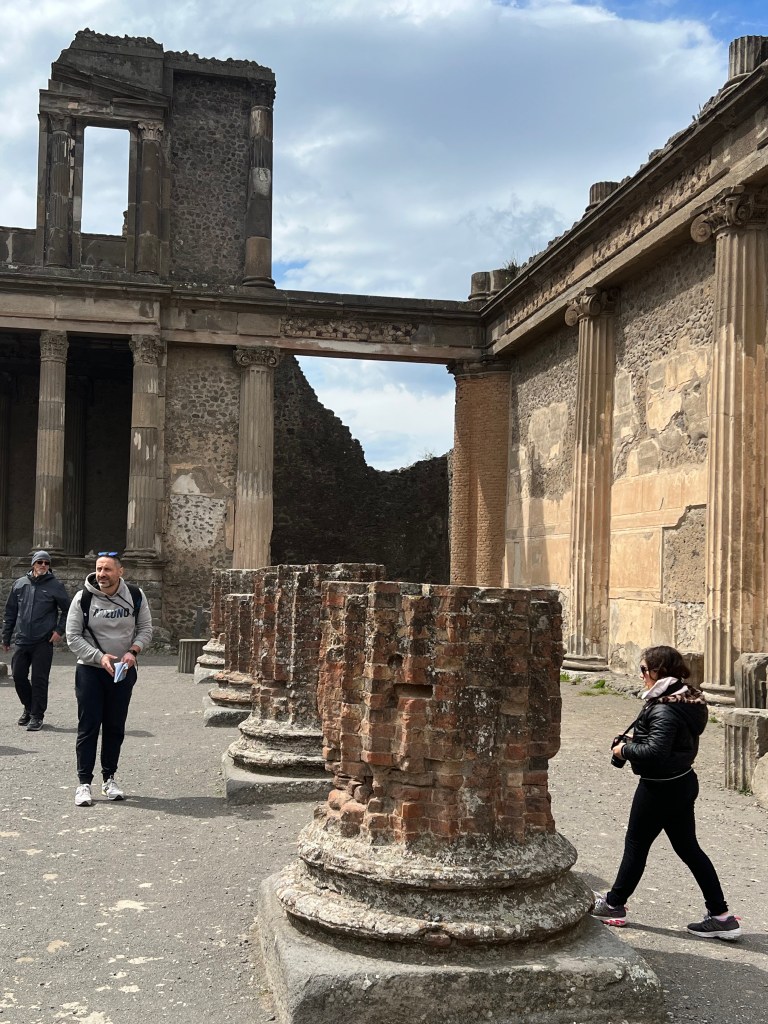
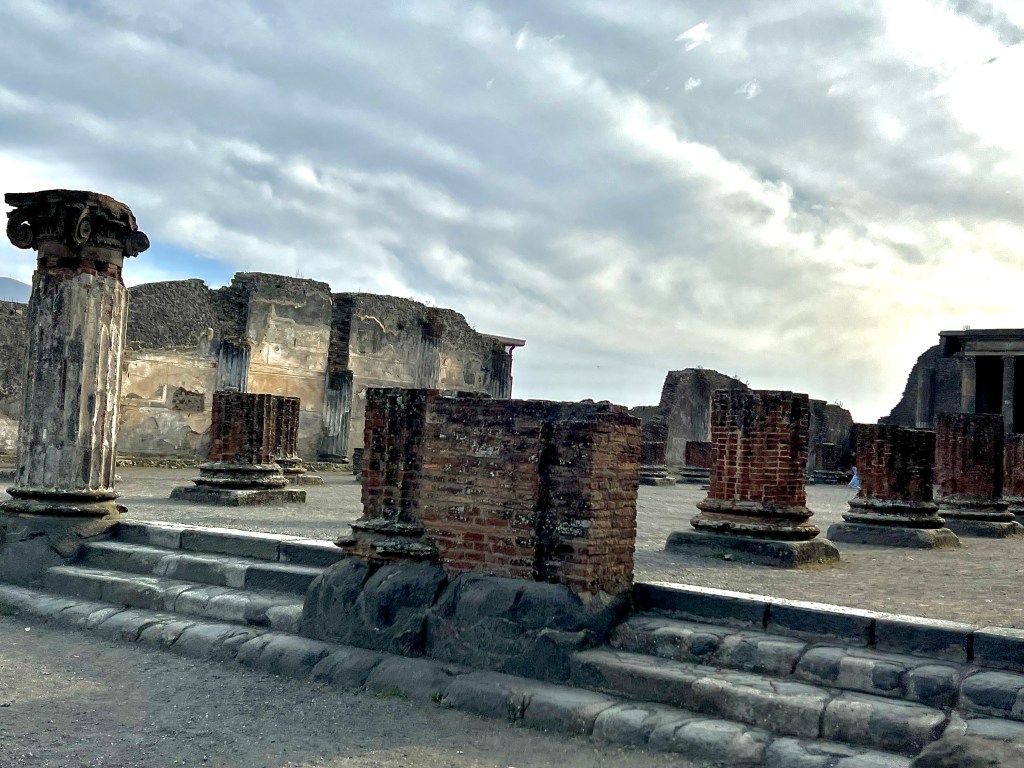
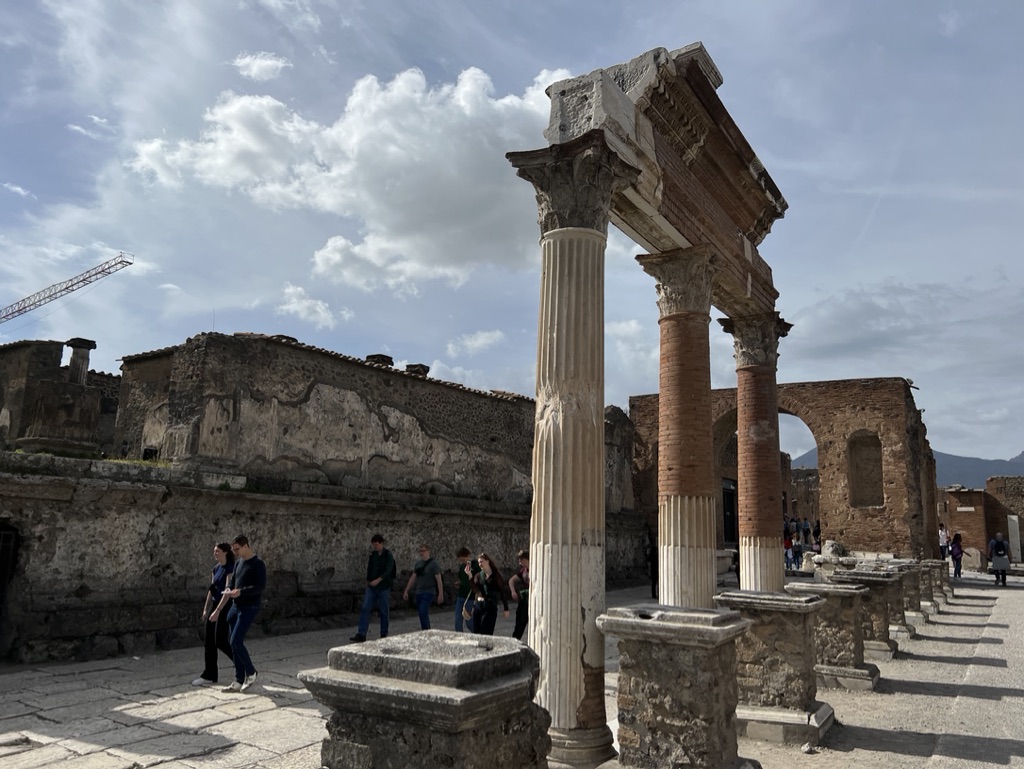
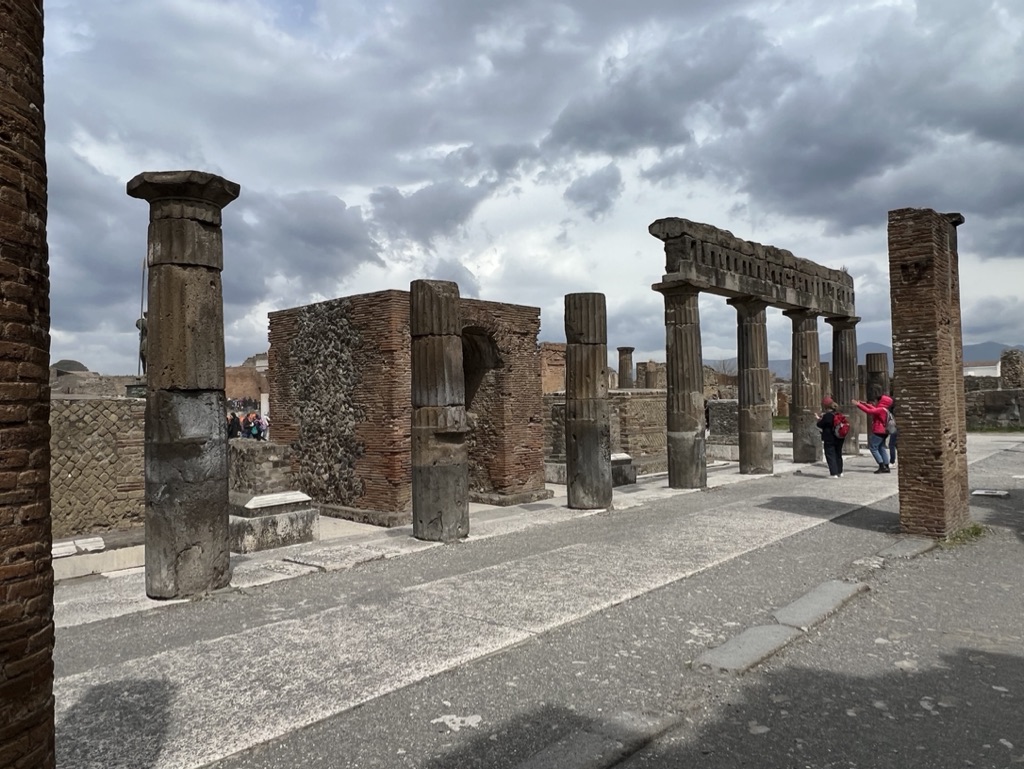
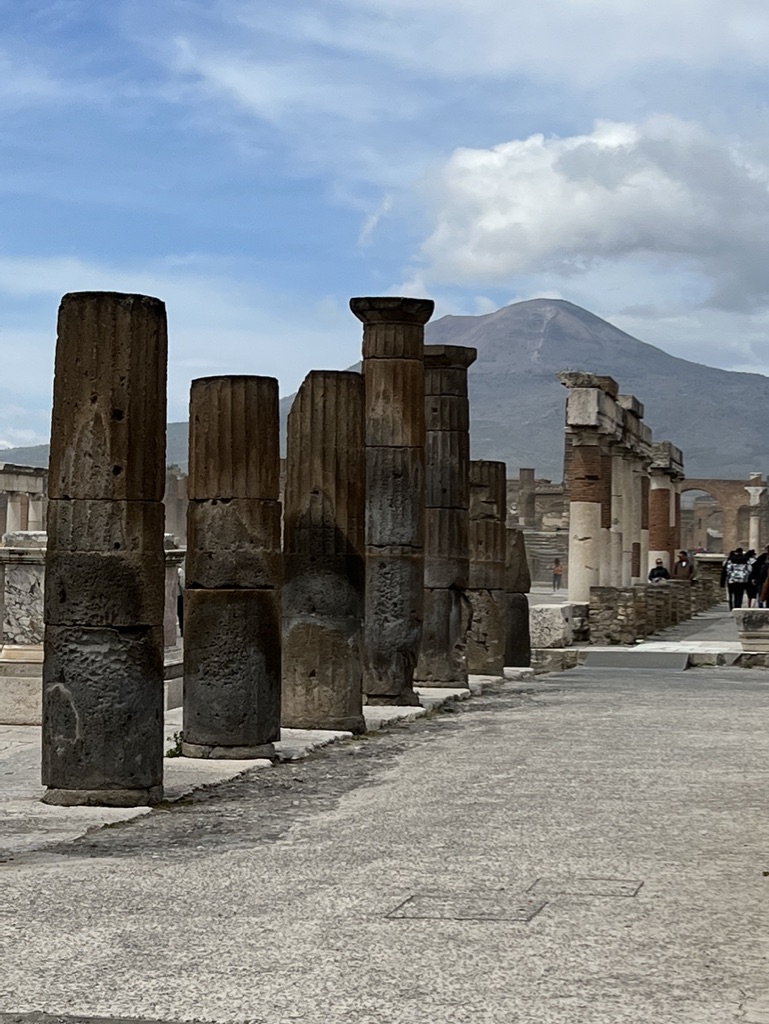
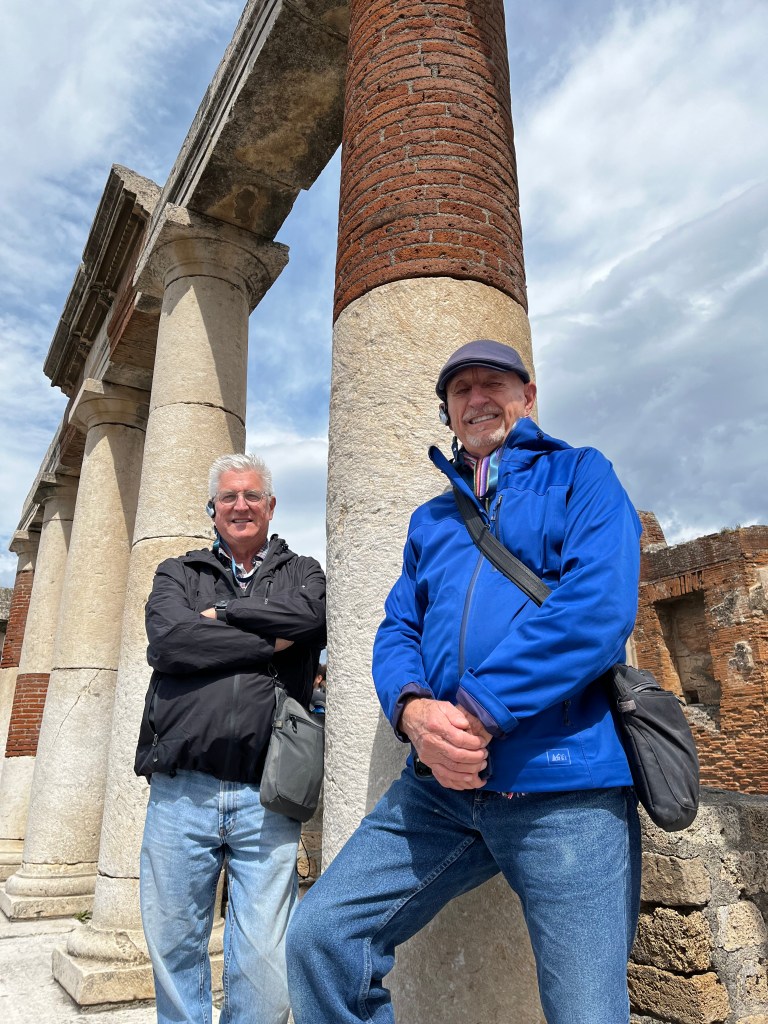
The forum or main gathering place in Pompei would have been near the sea port and was a gathering place and place of business for vendors. In the large open space one could imagine all the activity and bustle as sailors of the time came ashore and merchants came to conduct business. It was a place of commerce and certainly much wealth and monies were exchanged. One way of making money would have been to rent a chariot, cart or wagon as the streets were designed so that only the local vehicles were able to fit on the streets.
Vesuvius rent a chariot? (motto: we bury the competition).
Returning to a subject I mentioned earlier in this story, I would be remiss in not mentioning that brothels, known as Lupanar, were also a daily aspect of life in Pompei. Lupanar is Latin for “brothel”. The Pompeii lupanar is also known as Lupanare Grande or the “Purpose-Built Brothel”. After becoming a Roman Colony, Pompeii was closely associated with Venus a deity of sex and a mythological figure closely tied to prostitution. According to our guide, most businesses closed down mid day when men might go to the baths and/or to seek some pleasure at the bordellos. Likewise, arriving visitors might be in search of some carnal pleasure and could find the location of their desire by looking for the etched phalluses in the streets or on buildings – pointing the way. According to my research, both women and men were employed in the sex trade in lupanare. Most of the sex workers were slaves.
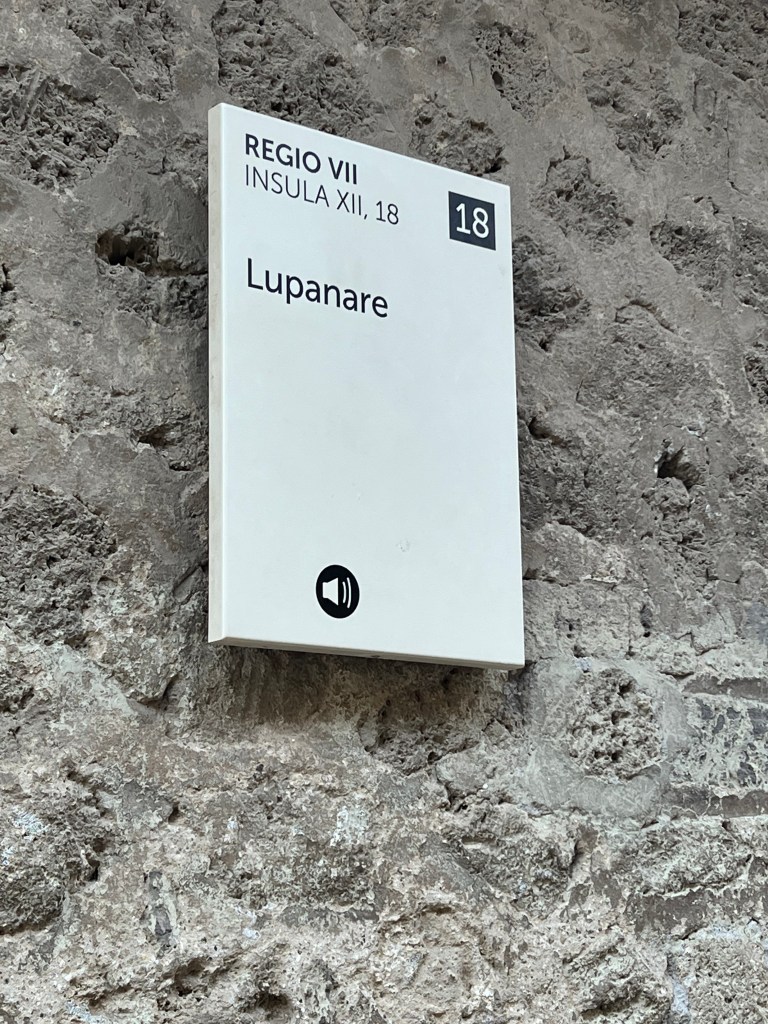
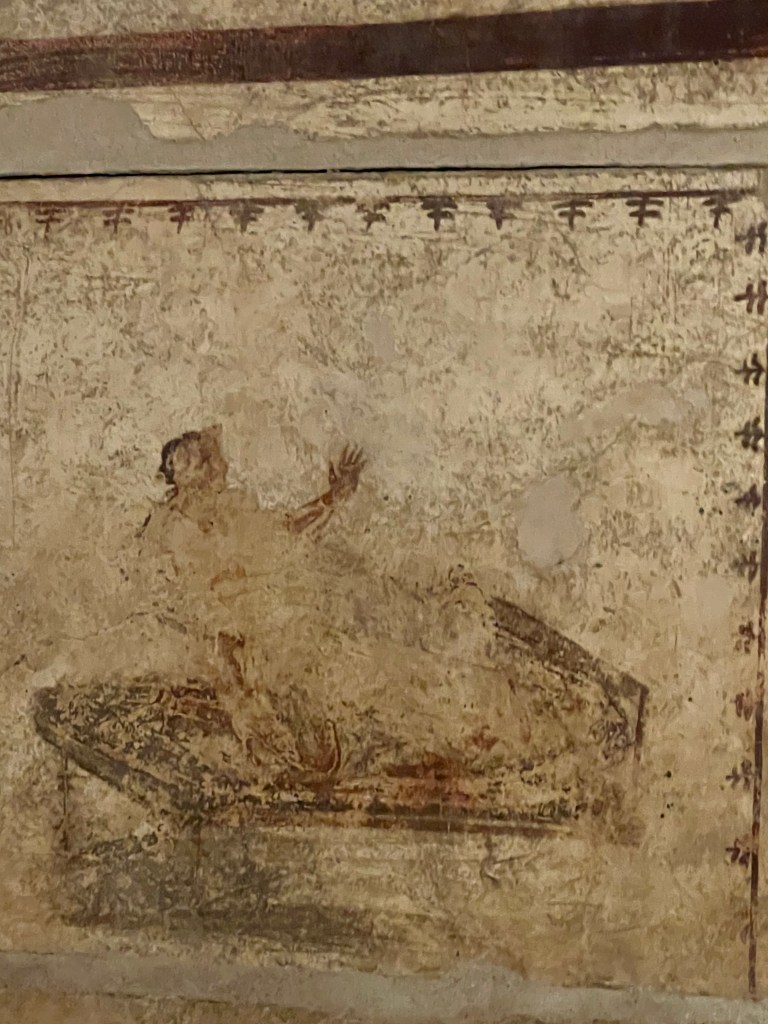
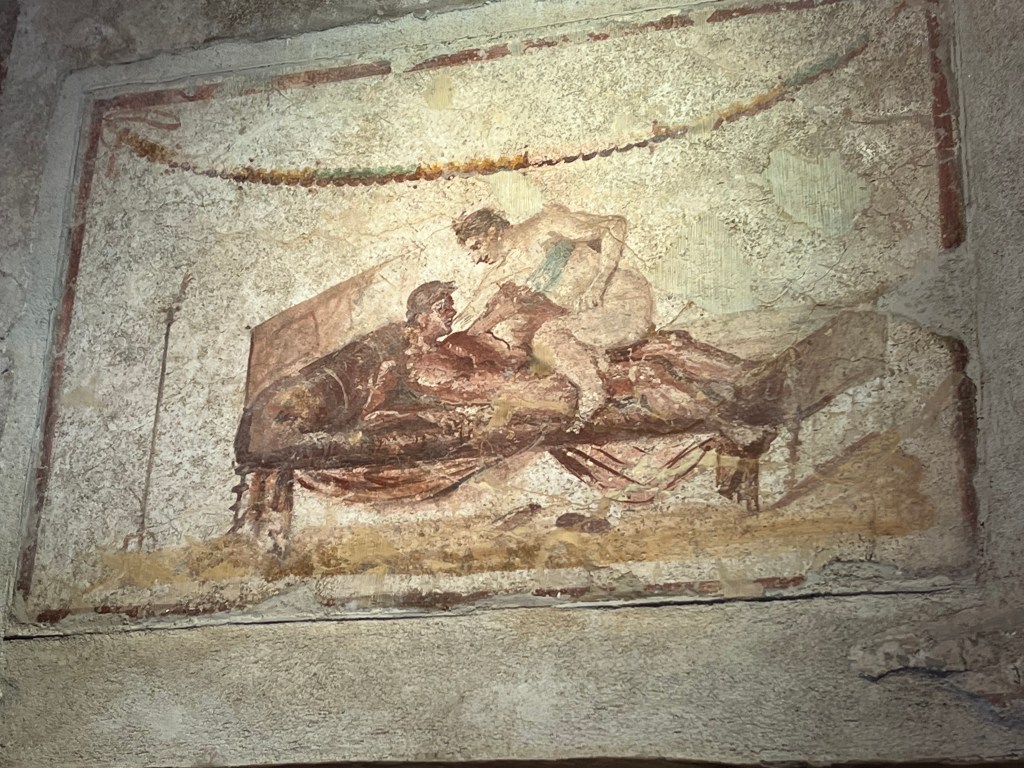
Rooms in the brothels were small with a stone bed, probably with a mattress. Above a room was an erotic painting of a sexual position that might be the experience a man were seeking. That would be the sex worker’s particular specialty. Fountains were nearby on the streets, where water would be fetched to help keep things clean.
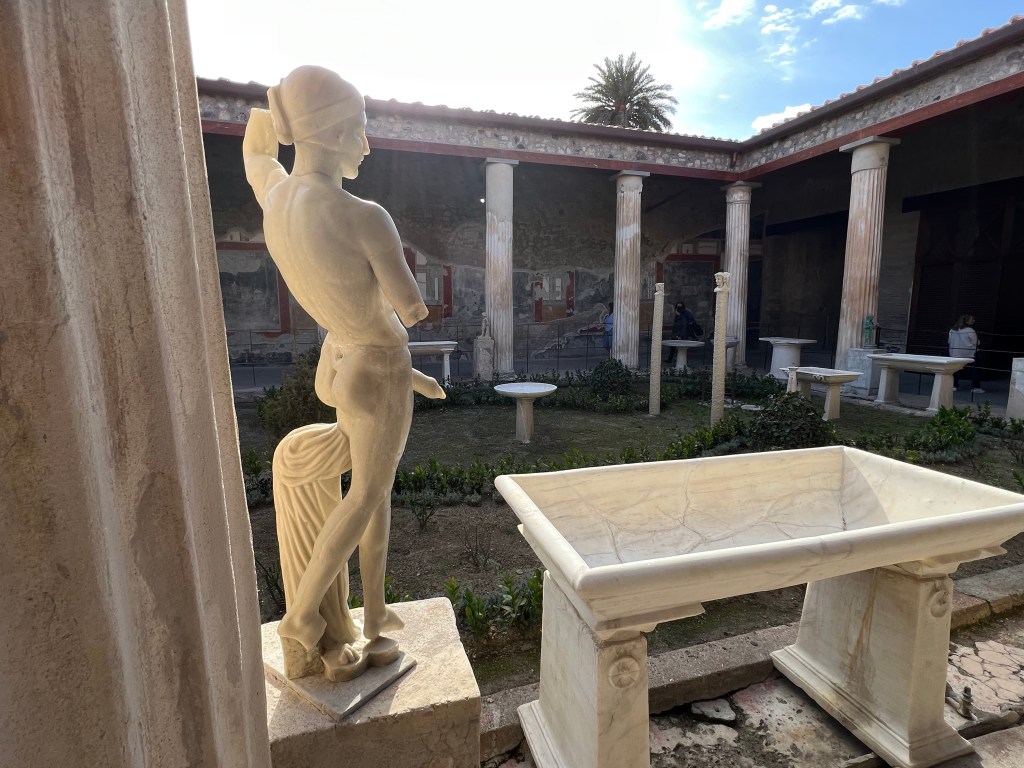
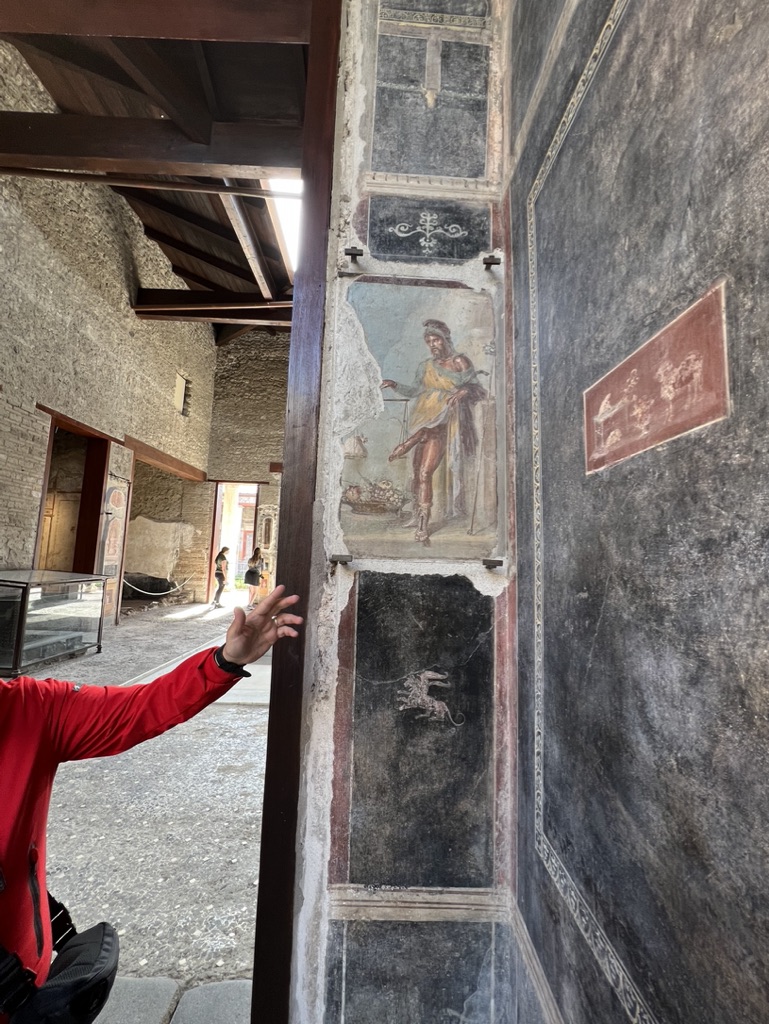
Oh, but the carnal nature of man doesn’t end there. Common in Greek and also Latin mythology is Priapus, a mythological character who was cursed with impotence although he was endowed with an prodigious (enormous) penis. Some of that era believed Priapus brought good luck and in the House of Vettii, he is a featured fresco in that villa’s entryway as well as the water source for the courtyard fountain.
Our second tour was as enlightening as the first, but Mark and I had passes that allowed us free range after the organized tour ended. We ventured off into other parts of the ruins discovering many more sites that are uncovered. One area near the entrance was a court where justice was dispensed to lawbreakers.
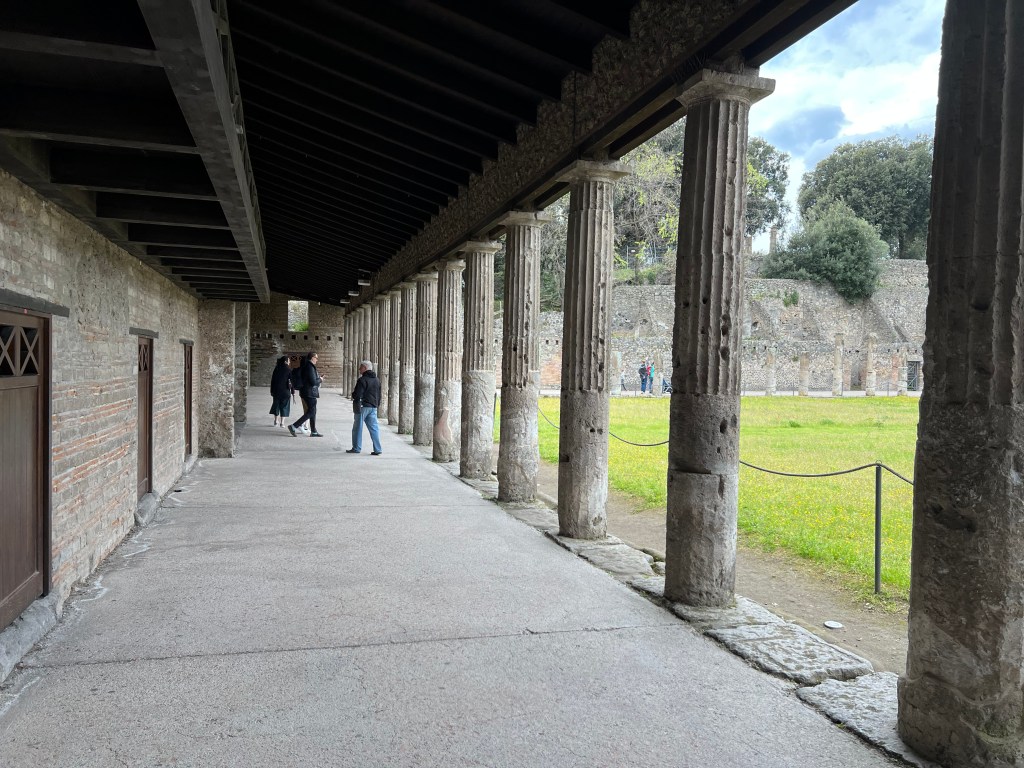
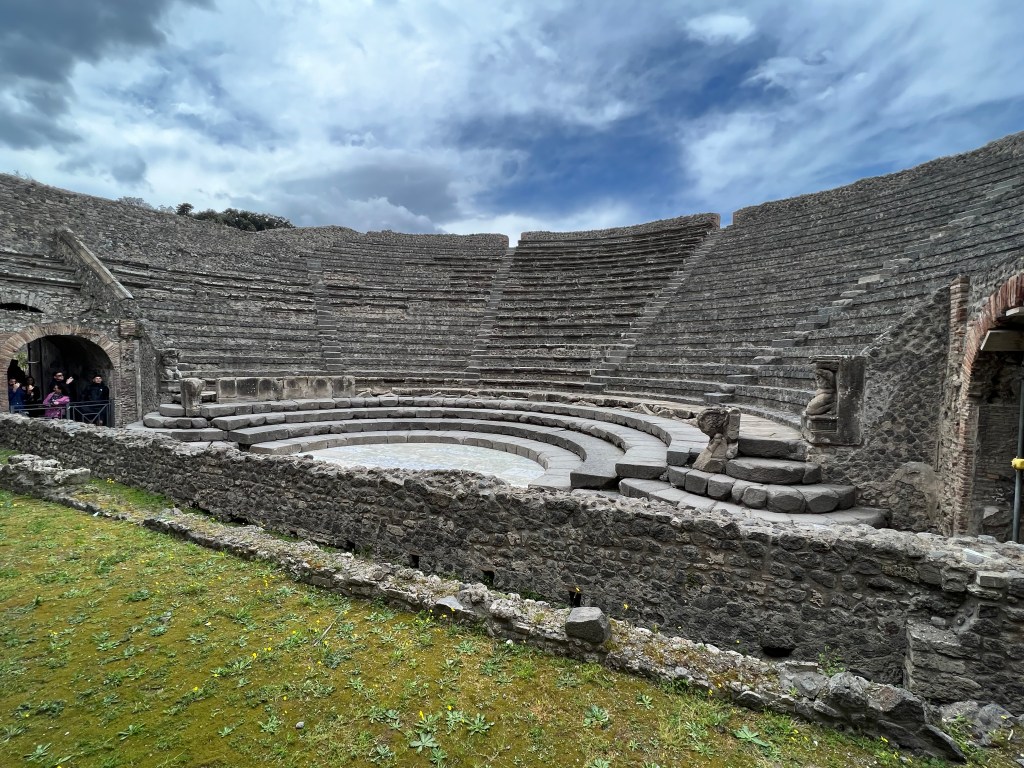
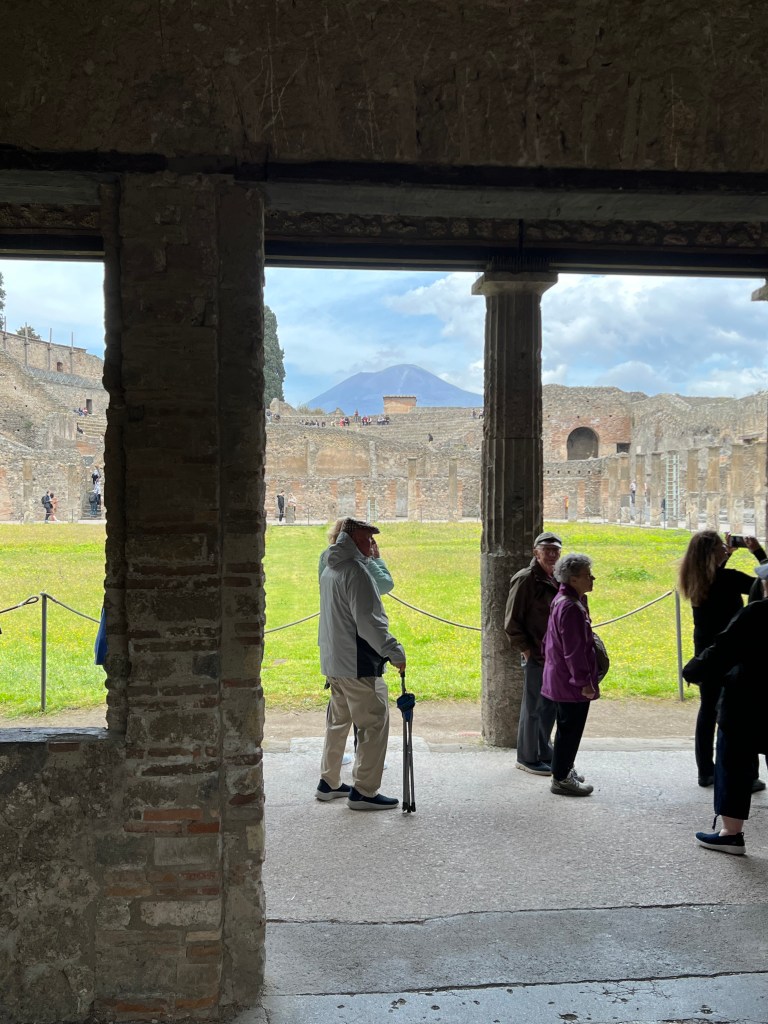
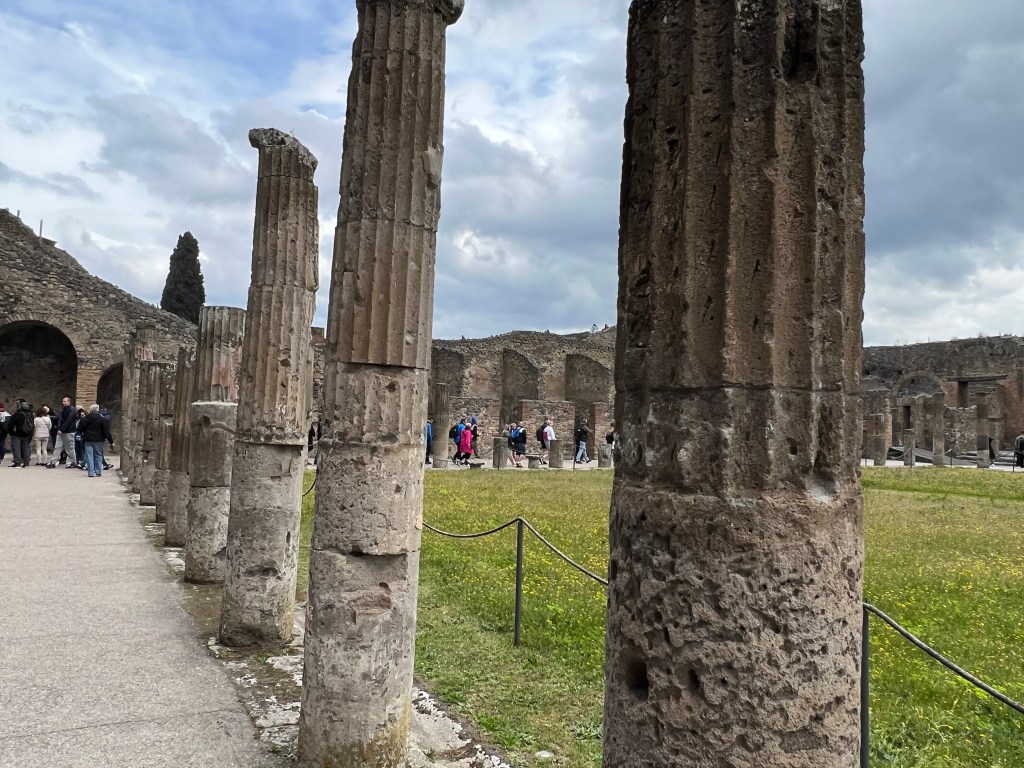
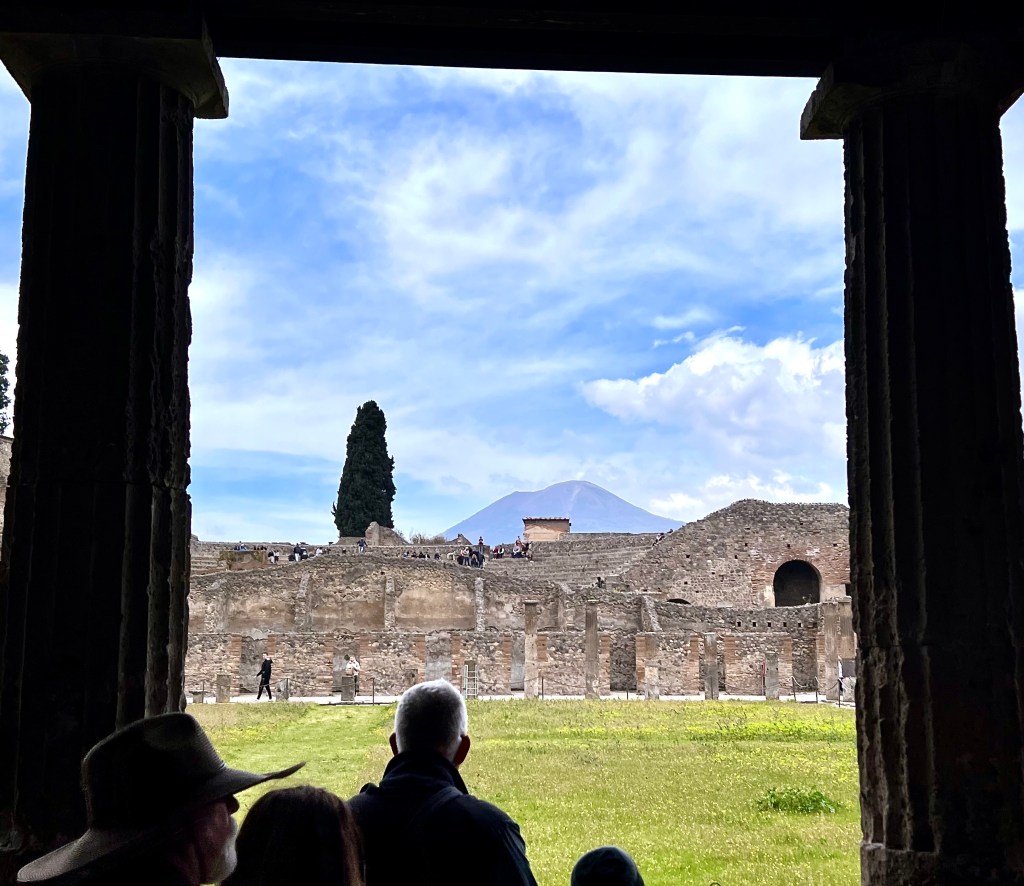
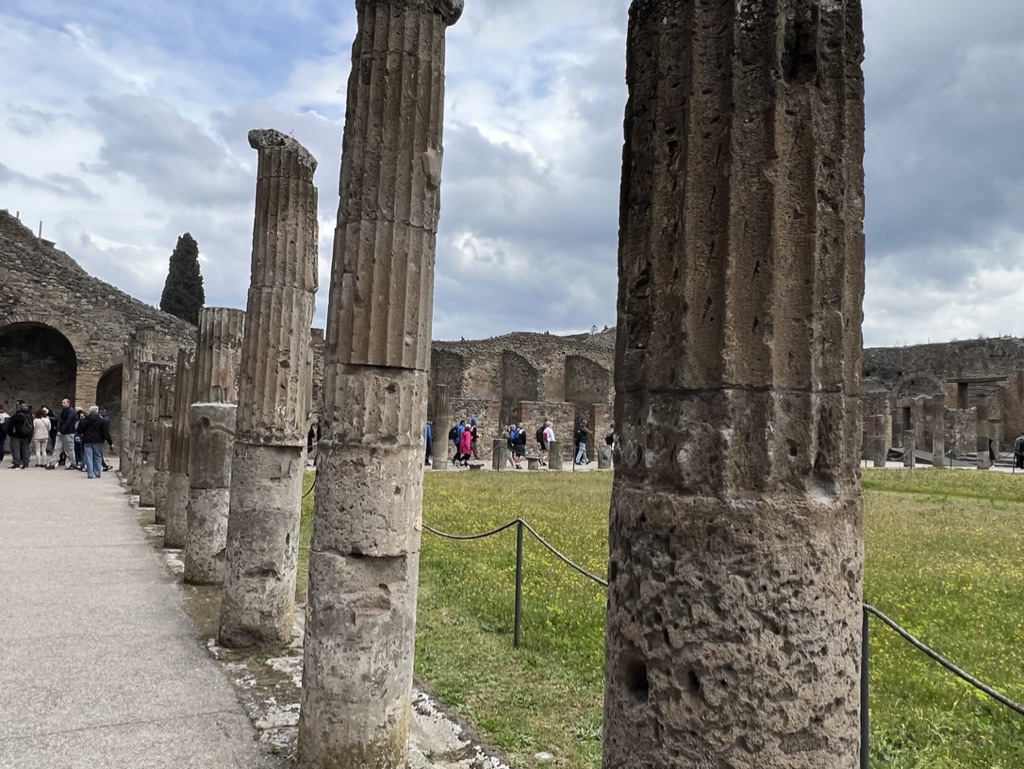
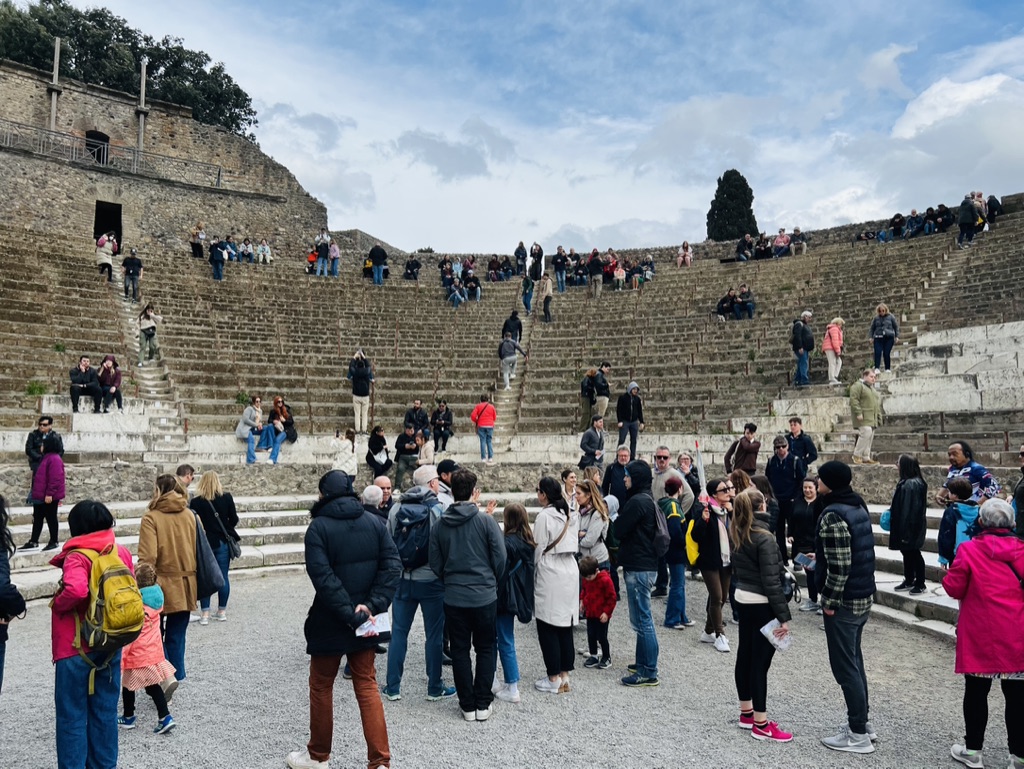
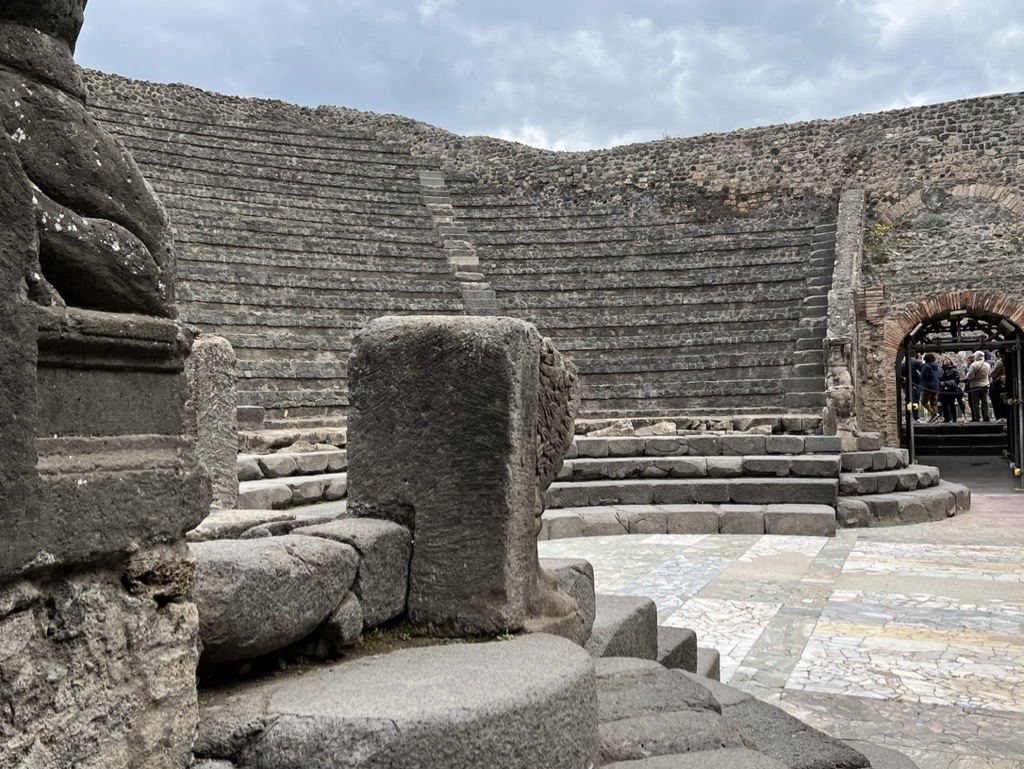
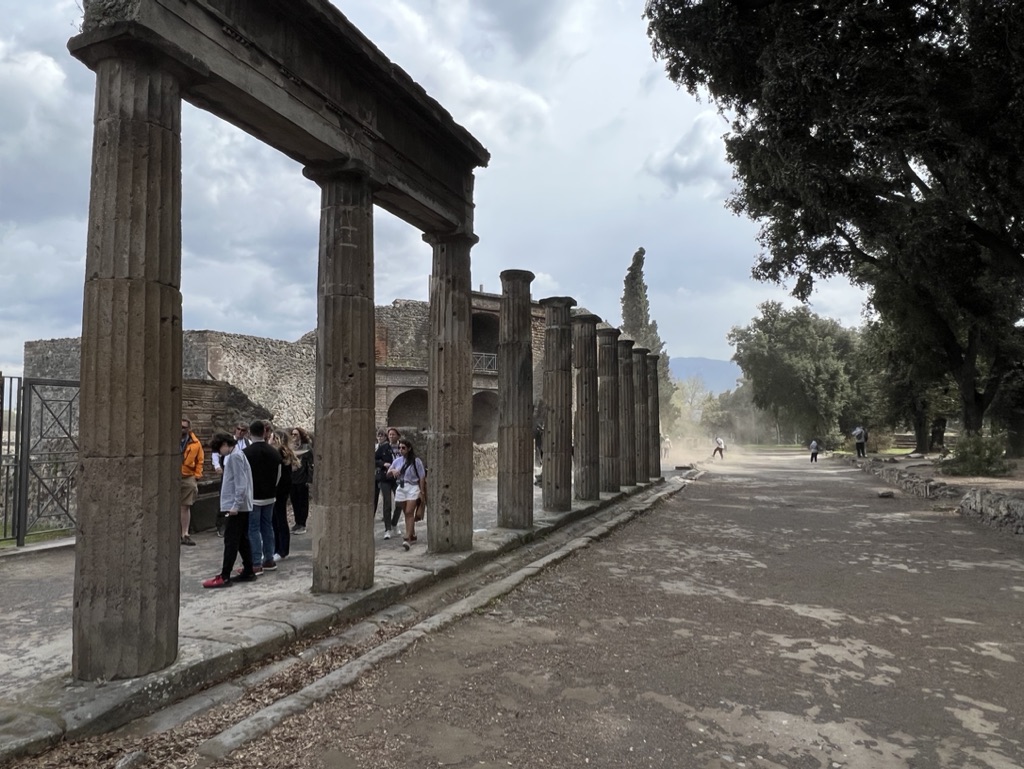
We visited the area where gladiators lived and trained in a large columned area. Nearby were a larger and a smaller amphitheater where performances were held. In the distant background Mt. Vesuvius rose beyond the walls of Pompei.

To be in this place was somewhat sobering when one considers the way of life that the residents were enjoying and prospering, when, in such a rapid development their lives ended, frozen in this time capsule of a buried city
After the tour and a light meal, we contacted Giuseppe and, once again, he returned for us, smiling broadly upon his arrival. At the hotel he once again thanked us while giving us pecks on our cheeks. We really lucked out in having Giuseppe as our driver.
If you ever travel to Pompei, we both highly suggest taking at least two separate tours, preferable at different times of day and at least one that allows you to stay on after the organized tour ends.
That evening we prepared for departure the following day to Naples for an early morning train ride to our final city – Rome.



 Waves In The Desert
Absolutely Beautiful – and haunting. Thank you for taking the time to share your adventures and talents.
LikeLike
Wonderful. I am so glad you kept such comprehensive notes and are sharing them like this.
LikeLike
Most sobering to think of how all those inhabitants spent their last minutes on earth. BIG-Sister, Janice
LikeLike
Good Morning, I never was able to tour Pompei What an incredible place. All that history and the ruins are remarkable.
LikeLike